On Failure in Metallic Materials

As a continuation of my series on composite materials and health monitoring, I wanted to talk about failure in composites. In writing it, I decided that first I needed to talk about failure in metallic materials. In writing that, it turned out that it was long enough to be a separate post by itself. So here it is, a small primer on failure, especially in metallic materials.

We’ll talk about composites next time.

What exactly is "failure"?

A component is said to have failed when it can no longer perform the task that it was designed for. Failure does not necessarily mean breaking, although sometimes it might. Failure in an engineering sense has as much to do with “what the designer intended” as with “the physical structure itself”.

For example, a bridge may be getting old and developing some cracks here and there. At what point do you say that the bridge is “unsafe for use”? The design and engineering teams set up some criteria to evaluate the structure. For example, they might say that “any cracks detected must not be greater than so-and-so length”. This does not mean that the bridge is going to break apart when a crack of that so-and-so length appears. It just means that the engineers are no longer satisfied with how the bridge may hold up in the future. Hence, the bridge component that developed the big-enough crack will be said to have failed.
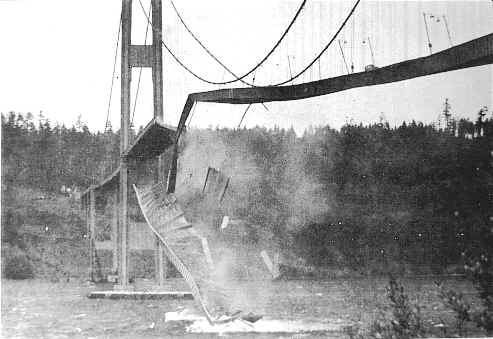
Tacoma Narrows Bridge

Tacoma Narrows Bridge. (Source)

If the above paragraph seems to convey unnecessary caution on the part of the engineer (why call the bridge unsafe if it isn’t breaking up?), consider that a bunch of reasons go into making such decisions. As an example, the engineers may consider their ability to detect every crack. The engineering team may consider the possibility that they could not detect some defects. What is the probability of a serious defect not being detected?

And there’s good reason to be cautious – if they get it wrong, bridges do collapse.

How do metallic materials fail?

In the previous section, we have been talking about cracks. Here’s why they form in the first place. Cracks form when the load on a given region of a component (i.e. stress, = force per unit area) becomes higher than what the material can handle. This may be because an unexpected amount of load was put on the structure that it was never designed for. It may also be that the capacity of the structure to withstand stresses has diminished over time as the component has aged. In any case, when the stress is too much for the component to bear, the component fractures and develops a crack. The particular mechanics of the fracture itself is a vast area of study in itself, and is way beyond the scope of this piece. Suffice to say, that crack formation weakens the component, and the larger the crack gets, the worse in condition the component becomes. Ultimately, the crack will grow large enough that the component will break into two, and will be unable to take any load at all.
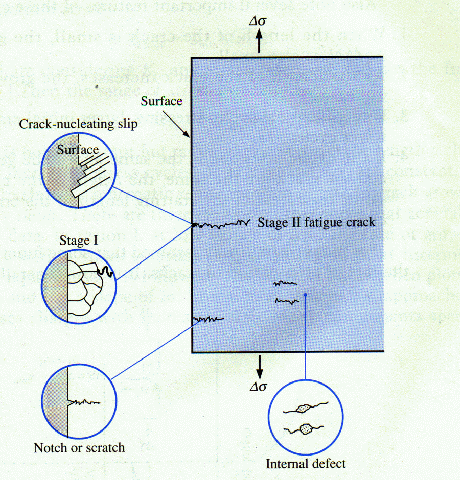
Crack propagation under fatigue loading

Crack propagation under certain conditions. (Source)

For metallic components, since the material itself is nominally homogenous (nominally, because nothing can be perfectly homogenous, but for all intents homogeneity may be assumed), the crack that ultimately causes the material to fail usually occurs where the stress happens to be the greatest. Further, as I mentioned above, the formation of a crack weakens the material, and so once a crack does form, any further worsening in that region accumulates around the same crack (weak zone) instead of creating new cracks all the time. “Where the stress is greatest” usually depends on the geometry of the component, on how the loads are distributed, and, indeed, on tiny variations in the homogeneity of the material itself.

Crack propagation in glass shot at extremely high frame rate. (Source)

For metals, therefore, the mantra for evaluating the component may be condensed as: “follow the cracks”. Wherever a crack seems to be worsening, is where final failure will most likely occur.

That’s it for today’s discussion on crack propagation; next time we’ll get to what I had actually set out to discuss – failure in composites.


‘It looked fine from the outside.’

An old building in Secunderabad collapsed today. The building was used as a hotel, which means that quite a lot of people were inside when it happened. Although some of those people have been rescued, 11 people have already been declared dead, and many more are still trapped inside.

Some points from the report–

  • The hotel was planning to build an oven on the first floor (this is India, which means they’re talking about the ‘second floor’ in American parlance). The building may have collapsed under the weight of bricks being transported for this; the building lacked concrete pillars to support the weight.
  • The building had structural weaknesses, but the hotel was not issued safety notices (recently, along with many other buildings) because “the building looked fine from outside”.
  • “In future, all buildings over 60 years old will be given orders for renovation,” says the city planning commissioner.

This is appalling, on a number of counts.

  • Did the hotel seek permission from the city planning commissioner’s office before undertaking their oven-building project? If not, this is gross negligence on the part of the hotel authorities. They are presumably not experts in structural engineering, and should not be in a position to judge the capabilities of a structure.
  • ‘Looked fine from the outside’ is not a structural health monitoring technique. However much the city planning commission tries to blame anyone else, they were grossly negligent too. Laziness in health monitoring of public structures causes lives, and they should know and acknowledge that.

    Health monitoring norms and procedures are in place for a reason, and even the most exhaustive and advanced health monitoring techniques don’t work if ‘looked fine from the outside’ is treated as an adequate criterion.

  • How about, instead of treating every building older than 60 years as needing renovation, the city planning commission does its job of inspecting buildings thoroughly? The problem isn’t that they can’t identify structural flaws—they’ve recently issued notices to 57 other buildings recently. It’s just that this building fell through the cracks, because ‘it looked fine from the outside’.

    The problem with the diktat about 60 year old buildings is that it increases the overall cost of maintaining buildings, and decreases the efficiency of health checks. Even well designed buildings, which are for all intents in great shape, will be forced to undergo renovations, or at least exhaustive checks, when they clearly don’t need them. On the one hand this increases the overall cost of inspection and renovation, because you’re spending resources where they’re not needed. On the other it increases the risk of ‘it looks good from the outside’ assessments. This is because the more the number of buildings tested that turn out to be perfectly healthy, the more the officers are prone to become lax and take shortcuts in making assessments.

    Instead, why not improve the work ethic of the inspection officials? Why not make them actually follow the health monitoring guidelines, and make sure that buildings that actually need detailed renovations are the only ones that get notices?

–

Can you tell that the line about ‘it looked fine from the outside’ has irked me? It has. Structural health monitoring is extremely important for public safety, and such negligence should have no place here. Compare this with a recent tragic story of a building inspector in Philadelphia, USA, who apparently committed suicide because a building collapsed under his watch–even though he had nothing to do with it:

A city building inspector who examined a demolition project just weeks before a building collapsed at the site and killed six people has been found dead in an apparent suicide […]

“This man did nothing wrong,” Mr. Gillison [deputy mayor for public safety and chief of staff] added. “The department did what it was supposed to do under the code at the time.” Officials have said they will make any necessary changes to the city’s building code to prevent such incidents in the future.

Some accidents, like the one in Philadelphia, are unavoidable, and it is indeed tragic when the building inspectors blame themselves. The whole point of health and safety standards, and inspection codes and permissions, is to avoid accidents where possible, and the whole system stands on inspectors and officials with acute eyes and sharp skills.

The collapse in Secunderabad is sad and tragic, but the most important question is and should be—was it avoidable? Apparently it was. Does Secunderabad need a change in safety standards? Only the planning commissioner’s office can determine that—although they’d do well to remove ‘it looked fine from the outside’ from their manuals.