<?xml version="1.0" encoding="utf-8"?>
<feed xmlns="http://www.w3.org/2005/Atom">

    <title><![CDATA[arnabocean]]></title>
    <link href="https://arnabocean.com/atom.xml" rel="self"/>
    <link href="https://arnabocean.com"/>
    <updated>2026-05-05 04:20:29</updated>
    <id>https://arnabocean.com/</id>
    <author>
        <name>Arnab Gupta</name>
        <avatar>https://arnabocean.com/images/agportrait.jpg</avatar>
    </author>
    <generator uri="https://blog.getpelican.com">Pelican</generator>

    <entry>
        <id>https://arnabocean.com/frontposts/2026-05-05-raghu-rai-passes-away/</id>        
        <updated>2026-05-05 00:00:00-04:00</updated>
        <title type="html"><![CDATA[Photographer Raghu Rai passes&nbsp;away]]></title>
        <link href="https://arnabocean.com/frontposts/2026-05-05-raghu-rai-passes-away/"/>
        <content type="html"><![CDATA[<p>Raghu Rai, amongst the very best in photo-journalism, passed away a few days ago at the age of 83. If you don’t know <a href="https://en.wikipedia.org/wiki/Raghu_Rai">who he is</a> is or what he is famous for, do yourself a favor and <a href="https://raghuraifoundation.org/the-collection/">check out his archives</a>. Especially, see his portrayal of <a href="https://raghuraifoundation.org/kolkata/">Kolkata</a>, his <a href="https://raghuraifoundation.org/retrospective-b-w/">black and white work</a>, and also his haunting, heart-wrenching, and yet, completely matter-of-fact capture of <a href="https://raghuraifoundation.org/bhopal/">Bhopal and its victims</a> in the aftermath of the <a href="https://en.wikipedia.org/wiki/Bhopal_disaster">gas tragedy</a>. </p>
<p>My first exposure to his work was during my time at Jadavpur University Photographic Club (<span class="caps">JUPC</span>) during my undergrad days, when as a budding photographer I went to a couple of his exhibitions in Kolkata. One was his follow-up coverage to see, and show, the Bhopal victims after a couple of decades. I had seen nothing like it, and it left a deep impression on me. He was capturing tragedy and horror, he was telling peoples&#8217; stories; there was something serene and poignant in his imagery, and yet something captivatingly prosaic. <em>I felt like I was&nbsp;there.</em></p>
<p>Photo-journalism is inherently opinionated, and always wants to do two things— tell a story, and capture realism. Any event can be captured in photos from multiple perspectives, and every photographer <em>has to</em> choose one perspective over another. The good photo-journalist knows how to capture and portray the core truth (in their opinion) of the event in their lens, while telling a story, and capturing impactful photographs. There was no one better at it than Raghu Rai. Every story that he has covered, you will find his opinion, his perspectives, and feel the story in your mind’s eye and your heart’s&nbsp;strings. </p>
<p>Alas, I never had the fortune to meet him in person during my <span class="caps">JUPC</span> days, but as I said above, his photography had an outsize impact in how I thought about my own&nbsp;photography. </p>
<p>Rest in peace,&nbsp;sir. </p>]]></content>
        <categories><category><![CDATA[Articles]]></category><category><![CDATA[people]]></category><category><![CDATA[photography]]></category><category><![CDATA[culture]]></category><category><![CDATA[society]]></category></categories>
    </entry>
    <entry>
        <id>https://arnabocean.com/frontposts/2026-04-15-finding-our-galactic-home/</id>        
        <updated>2026-04-15 00:00:00-04:00</updated>
        <title type="html"><![CDATA[☞ Finding our galactic home&nbsp;(Youtube)]]></title>
        <link href="https://youtu.be/zZ0yxOQyKF0?si=IrfX61XGn6e4JMD5"/>
        <content type="html"><![CDATA[<p>What a beautiful simulated rendition of our place in the universe, by answering the hypothetical question: &#8216;how would you find your way back home if you were stranded 1 billion light-years from Earth?&#8217; By the way, note the &#8216;every dot is a galaxy&#8217; and &#8216;every dot is a star&#8217; notations as the video zooms in. Also, if you&#8217;re curious about the Sun&#8217;s description as a &#8216;yellow dwarf&#8217;, yes, that&#8217;s the <a href="https://www.universeguide.com/fact/gyellowdwarfgiantstar">nomenclature</a>, although it&#8217;s a misnomer, and, as the video says towards the end, our Sun is <a href="https://en.wikipedia.org/wiki/G-type_main-sequence_star">perfectly unremarkable and ordinary</a>.</p>
<p>To me, videos like these are a reminder of how minuscule we are in the context of how big space is. For all our progress and technology, the farthest our probes have ventured is <em>juuust</em> <a href="https://en.wikipedia.org/wiki/Voyager_program">outside of the solar system</a>.</p>
<p>See also: <a href="https://www.youtube.com/watch?v=wupToqz1e2g&amp;list=RDwupToqz1e2g&amp;start_radio=1">Pale Blue Dot, by Carl Sagan</a>.</p><p><a href="https://youtu.be/zZ0yxOQyKF0?si=IrfX61XGn6e4JMD5">&#10166;</a> | <a rel="full-article" href="https://arnabocean.com/frontposts/2026-04-15-finding-our-galactic-home/">&infin;</a></p>]]></content>
        <categories><category><![CDATA[Link-Posts]]></category><category><![CDATA[milky way]]></category><category><![CDATA[galaxy]]></category><category><![CDATA[astronomy]]></category><category><![CDATA[science]]></category><category><![CDATA[video]]></category><category><![CDATA[youtube]]></category></categories>
    </entry>
    <entry>
        <id>https://arnabocean.com/frontposts/2026-03-30-Prince-of-persia-programming/</id>        
        <updated>2026-03-30 00:00:00-04:00</updated>
        <title type="html"><![CDATA[☞ Of the original Prince of Persia video game&nbsp;(Youtube)]]></title>
        <link href="https://www.youtube.com/watch?v=sw0VfmXKq54"/>
        <content type="html"><![CDATA[<p>If you&#8217;re old enough to have played — or watched! — any version of the original <a href="https://en.wikipedia.org/wiki/Prince_of_Persia">Prince of Persia</a> computer game, or, take an interest in design and/or programming, this Youtube video is for you. What a wonderfully charming retelling of how the game was developed, working within frugal memory limits of the <a href="https://en.wikipedia.org/wiki/Apple_II">Apple ][</a> for which it was originally&nbsp;developed.</p>
<p>And no, I&#8217;m not old enough either to have played the original on an Apple platform. My first sighting of this piece of art was in the late 1990s, on the computer of one of my dad&#8217;s friends. For me, these were the really early days, personal computers were starting to enter the mass market, and the teenage me was buckling in for the ride. If I remember correctly, I only played this game on <em>Mridul kaka&#8217;s</em> (translation: Mridul uncle&#8217;s) computer a couple of times, and I remember being completely awestruck by how fluid the character movements looked. This game was <em>gorgeous</em>. Those were the days when games were blocky <em>at best</em>, and Prince of Persia was just something else. As I said, a work of&nbsp;art. </p>
<p>And now I find out those fluid animations were based on real motion capture! In the 1980s! How unbelievably cool is that? Seriously, go watch, you won&#8217;t regret&nbsp;it.</p><p><a href="https://www.youtube.com/watch?v=sw0VfmXKq54">&#10166;</a> | <a rel="full-article" href="https://arnabocean.com/frontposts/2026-03-30-Prince-of-persia-programming/">&infin;</a></p>]]></content>
        <categories><category><![CDATA[Link-Posts]]></category><category><![CDATA[video games]]></category><category><![CDATA[programming]]></category><category><![CDATA[Apple]]></category><category><![CDATA[tech history]]></category><category><![CDATA[video]]></category><category><![CDATA[youtube]]></category></categories>
    </entry>
    <entry>
        <id>https://arnabocean.com/frontposts/2024-05-07-bertrand-serlet-why-ai-works/</id>        
        <updated>2024-05-07 00:00:00-04:00</updated>
        <title type="html"><![CDATA[☞ Bertrand Serlet — &#8216;Why <span class="caps">AI</span>&nbsp;works&#8217;]]></title>
        <link href="https://www.youtube.com/watch?v=QwtyIDmhxh4"/>
        <content type="html"><![CDATA[<p>If you take an interest in <em>why</em> — not how — the modern large language models work, this is a great 30-minute video lecture from Bertrand Serlet, former Senior Vice President of Software Engineering at Apple. This is a well-crafted, non-jargon talk to take in; at the very least, it&#8217;s a lesson in how to communicate a complex, mathematical topic in incremental, bite-size pieces without devolving into multi-layer flowcharts and&nbsp;equations.</p>
<p>I started watching because I remember Serlet from a couple of his hilarious presentations from his Apple days (watch <a href="https://www.youtube.com/watch?v=N-2C2gb6ws8&amp;pp=ygUPYmVydHJhbmQgc2VybGV0">here</a>, then <a href="https://www.youtube.com/watch?v=FTfChHwGFf0&amp;pp=ygUPYmVydHJhbmQgc2VybGV0">here</a>) poking fun at Microsoft, and I&#8217;m glad I didn&#8217;t skip this&nbsp;one.</p>
<p>If, after watching the video, you would like to follow up on the topic with some technical reading, I have you covered. <a href="https://en.wikipedia.org/wiki/Transformer_(deep_learning_architecture)">Transformers</a> are a type of deep neural network, specifically trained to make predictions based on chains of previous input, using the inherent contexts and relationships&nbsp;therein. </p>
<p>So, while an image classifier takes in a single image and predicts probabilities that the image contains specific objects, a transformer takes in a sequence of information pieces, chained together, and makes a contextual prediction. The prediction in this case tries to extend the input chain, which can be the next logical word, next logical pixel, next logical musical note,&nbsp;etc. </p>
<p>If you want to take a deep dive into building a simple <span class="caps">LLM</span> from scratch, you may start with <a href="https://www.youtube.com/watch?v=kCc8FmEb1nY">Andrej Karpathy&#8217;s tutorial</a>. Karpathy is <a href="https://en.wikipedia.org/wiki/Andrej_Karpathy">one of the co-founders</a> of OpenAI (makers of ChatGPT), and this is a very well put-together lecture. He also has an hour-long <a href="https://www.youtube.com/watch?v=zjkBMFhNj_g">&#8220;busy-person&#8217;s intro to LLMs&#8221;</a>.</p>
<p>Finally, if you <em>really</em> want to go into the rabbit-hole, this paper is what started the transformer revolution: <a href="https://arxiv.org/abs/1706.03762">Attention is all you need</a>. The <a href="https://arxiv.org/pdf/1706.03762">View <span class="caps">PDF</span></a> link will take you to the <span class="caps">PDF</span> version of the paper. This <a href="https://app.litmaps.com/preview/261105339">LitMaps link</a> will show you how influencial that paper has&nbsp;been.</p>
<p>But, seriously, forget all of the technical stuff. Go watch Bertrand&#8217;s video&nbsp;lecture. </p>
<p>P.S.: I should note, this is not an unconditional endorsement of <span class="caps">AI</span> in general and LLMs in particular. These technologies are being used, and may continue to be used, in ways that are <a href="https://arstechnica.com/information-technology/2023/02/sci-fi-becomes-real-as-renowned-magazine-closes-submissions-due-to-ai-writers/">unsavory</a>, <a href="https://fortune.com/2023/05/05/hollywood-writers-strike-wga-chatgpt-ai-terrifying-replace-workers/">short-sighted</a> and <a href="https://futurism.com/sports-illustrated-ai-generated-writers">dangerous</a>. We need to be circumspect and judicious in how we deploy these extremely powerful technologies, so that we don&#8217;t incur unacceptable costs in the long term. We should aim to <a href="https://www.cnbc.com/2023/08/05/why-graphic-designers-think-gen-ai-needs-them-as-much-as-they-need-it.html">bolster</a> our <a href="https://thescriptlab.com/blogs/35744-3-ways-to-use-ai-for-screenwriting/">creative</a> <a href="https://www.forbes.com/sites/davidhenkin/2023/12/05/orchestrating-the-future-ai-in-the-music-industry/?sh=8244c114f643">crafts</a> with <span class="caps">AI</span>, not foolishly attempt to replace human&nbsp;creativity.</p><p><a href="https://www.youtube.com/watch?v=QwtyIDmhxh4">&#10166;</a> | <a rel="full-article" href="https://arnabocean.com/frontposts/2024-05-07-bertrand-serlet-why-ai-works/">&infin;</a></p>]]></content>
        <categories><category><![CDATA[Link-Posts]]></category><category><![CDATA[LLM]]></category><category><![CDATA[AI]]></category><category><![CDATA[computing]]></category><category><![CDATA[programming]]></category><category><![CDATA[technology]]></category><category><![CDATA[tutorial]]></category><category><![CDATA[video]]></category><category><![CDATA[youtube]]></category></categories>
    </entry>
    <entry>
        <id>https://arnabocean.com/frontposts/2022-09-22-marple-christie-comeback-copy/</id>        
        <updated>2022-09-22 00:00:00-04:00</updated>
        <title type="html"><![CDATA[☞ Miss Marple makes a&nbsp;comeback]]></title>
        <link href="https://www.theguardian.com/books/2022/sep/15/feminist-icon-miss-marple-returns-in-12-new-authorised-mystery-stories-agatha-christie"/>
        <content type="html"><![CDATA[<p>The Guardian&nbsp;reports:</p>
<blockquote>
<p>The collection, titled Marple, marks the first time anyone other than [Agatha] Christie has written “official” (as recognised by the Christie estate) Miss Marple stories. The 12 women who contributed to the collection include award-winning crime writers Val McDermid and Dreda Say Mitchell, historical novelist Kate Mosse, classicist and writer Natalie Haynes and New York Times bestselling author Lucy&nbsp;Foley.</p>
</blockquote>
<p>(If the Guardian link above doesn&#8217;t work for any reason, here is an <a href="https://www.smithsonianmag.com/smart-news/twelve-writers-bring-back-agatha-christie-miss-marple-180980762">alternative link</a> from Smithsonian Magazine quoting The&nbsp;Guardian.)</p>
<p>This is great! Always room for more Marple mysteries for avid Christie readers such as&nbsp;me!</p>
<p>There have already been several new “official” Poirot novels, <a href="https://www.goodreads.com/series/184795-new-hercule-poirot-mysteries">written by Sophie Hannah</a>, also sanctioned by the Christie estate, that have been published in the last few years. I have read a couple of them, and they are pretty good reads! The author’s voice seems <em>just</em> that bit different — of course, that is to be expected, and indeed hoped for — and that’s a little jarring after years of reading Christie, but the plots and the characters are quite well-thought-written-fleshed-out. They won’t feel out of place amongst Christie’s Poirot&nbsp;mysteries. </p>
<p>If these new Marple stories are anywhere as good, then they will be worth looking out&nbsp;for. </p><p><a href="https://www.theguardian.com/books/2022/sep/15/feminist-icon-miss-marple-returns-in-12-new-authorised-mystery-stories-agatha-christie">&#10166;</a> | <a rel="full-article" href="https://arnabocean.com/frontposts/2022-09-22-marple-christie-comeback-copy/">&infin;</a></p>]]></content>
        <categories><category><![CDATA[Link-Posts]]></category><category><![CDATA[agatha christie]]></category><category><![CDATA[reading]]></category><category><![CDATA[literature]]></category></categories>
    </entry>
    <entry>
        <id>https://arnabocean.com/frontposts/2022-09-13-news-juxtaposed-climate-change/</id>        
        <updated>2022-09-13 00:00:00-04:00</updated>
        <title type="html"><![CDATA[News Juxtaposition: Climate&nbsp;Change]]></title>
        <link href="https://arnabocean.com/frontposts/2022-09-13-news-juxtaposed-climate-change/"/>
        <content type="html"><![CDATA[<p>Here are some news snippets from the last few&nbsp;weeks.</p>
<ul>
<li><a href="https://www.npr.org/2022/08/19/1118369938/the-yangtze-river-is-shrinking-as-drought-disrupts-the-worlds-no-2-economy">Yangtze shrinks as China&#8217;s drought disrupts industry (<span class="caps">NPR</span>)</a>  </li>
<li><a href="https://scitechdaily.com/drought-causes-yangtze-chinas-most-important-river-to-dry-up/">Drought Causes Yangtze – China’s Most Important River – To Dry Up&nbsp;(scitechdaily.com)</a></li>
</ul>
<blockquote>
<p>As China’s most important river, the Yangtze provides water to more than 400 million Chinese people. This summer, with rainfall in the Yangtze basin around 45% lower than normal, it reached record-low water levels with entire sections and dozens of tributaries drying up. The loss of water flow to China’s extensive hydropower system has created problems in Sichuan, which receives more than 80% of its energy from&nbsp;hydropower.</p>
</blockquote>
<ul>
<li><a href="https://www.cnbctv18.com/world/pakistan-flood-situation-to-worsen-as-indus-and-swat-to-swell-further-rain-fury-claims-nearly-1000-lives-14600701.htm">Pakistan Flood Situation To Worsen As Indus And Swat To Swell Further, Monsoon Fury Claims Nearly 1,000 Lives&nbsp;(cnbctv18.com)</a>  </li>
<li><a href="https://www.wtoc.com/2022/08/29/international-aid-reaches-flood-ravaged-pakistan-more-than-1000-have-died-this-summer/">Pakistan floods leave more than 1,000 dead, a half million survivors in camps&nbsp;(wtoc.com)</a></li>
</ul>
<blockquote>
<p>Nearly a half million people crowded into camps after losing their homes in widespread flooding and the climate minister warned Monday that Pakistan is on the “front line” of the world’s climate crisis after unprecedented monsoon rains wracked the country since mid-June, killing more than 1,130&nbsp;people.</p>
</blockquote>
<ul>
<li><a href="https://www.tampabay.com/news/florida-politics/2022/08/12/floridas-latest-insurance-crisis-was-decades-in-the-making/">Florida’s latest homeowners insurance crisis is a mess decades in the making&nbsp;(tampabay.com)</a></li>
</ul>
<blockquote>
<p>The drama is just the latest problem as the state experiences its biggest insurance crisis since Hurricane Andrew in 1992. [&#8230;] In the last two years, more than 400,000 Floridians have had their policies dropped or nonrenewed. Fourteen companies have stopped writing new policies in Florida. Five have gone belly-up in 2022 alone. The record, set after Hurricane Andrew’s devastation, is eight in one&nbsp;year.</p>
<p>The latest casualty was Coral Gables-based Weston Property <span class="amp">&amp;</span> Casualty, which leaves 22,000 policyholders — about 9,400 in South Florida — scrambling to find new insurance&nbsp;companies.</p>
<p>Costs also have skyrocketed. In 2019, when DeSantis was sworn in, Floridians paid an average premium of $1,988. This year, it’s now $4,231, triple the national average, according to an Insurance Information Institute&nbsp;analysis.</p>
</blockquote>
<ul>
<li><a href="https://www.theguardian.com/environment/2022/aug/29/major-sea-level-rise-caused-by-melting-of-greenland-ice-cap-is-now-inevitable-27cm-climate">Major sea-level rise caused by melting of Greenland ice cap is ‘now inevitable’ (The&nbsp;Guardian)</a></li>
</ul>
<blockquote>
<p>[T]he study published in the journal Nature Climate Change used satellite measurements of ice losses from Greenland and the shape of the ice cap from 2000-19. This data enabled the scientists to calculate how far global heating to date has pushed the ice sheet from an equilibrium where snowfall matches the ice lost. This allowed the calculation of how much more ice must be lost in order to regain&nbsp;stability.</p>
<p>The research shows the global heating to date will cause an absolute minimum sea-level rise of 27cm (10.6in) from Greenland alone as 110tn tonnes of ice melt. With continued carbon emissions, the melting of other ice caps and thermal expansion of the ocean, a multi-metre sea-level rise appears&nbsp;likely.</p>
<p>“It is a very conservative rock-bottom minimum,” said Prof Jason Box from the National Geological Survey of Denmark and Greenland (Geus), who led the research. “Realistically, we will see this figure more than double within this&nbsp;century.”</p>
</blockquote>
<p>Climate change is happening, our civilization as it currently stands will be upended because of it, and we as a global society have done (next to) nothing to mitigate it. The best time to take measures to decelerate climate change was decades ago; the next best time is right now. Either we grit our teeth and hold our breath through a couple of decades of accelerated, painful, transition to sustainable energy use, or&#8230; we will be forced to hold our breath under water as our coastal life&nbsp;submerges.</p>
<p>By the way, <a href="https://www.un.org/esa/sustdev/natlinfo/indicators/methodology_sheets/oceans_seas_coasts/pop_coastal_areas.pdf">40% of the world&#8217;s population lives within 100km (60mi) the coast</a>. </p>]]></content>
        <categories><category><![CDATA[Articles]]></category><category><![CDATA[news]]></category><category><![CDATA[climate]]></category><category><![CDATA[climate change]]></category><category><![CDATA[science]]></category></categories>
    </entry>
    <entry>
        <id>https://arnabocean.com/frontposts/2022-06-28-RitamSen-Prasen-Nao/</id>        
        <updated>2022-06-28 00:00:00-04:00</updated>
        <title type="html"><![CDATA[Music: lyrics for Nao, by Ritam Sen, Prasen, and Hoodkhola&nbsp;Kobitara]]></title>
        <link href="https://arnabocean.com/frontposts/2022-06-28-RitamSen-Prasen-Nao/"/>
        <content type="html"><![CDATA[<p>This is such a beautiful song; if you haven’t heard it, <a href="https://youtu.be/nfOvPoJl7WM">here’s a version</a> on Youtube! (There are a couple other versions, such as <a href="https://youtu.be/5PPqWLDPZHQ">this one</a>, also&nbsp;great.)</p>
<p>Hat tip to <a href="https://www.instagram.com/poorna_goswami/">Poorna</a> for making me listen to this on one of our uncountable night drives; it has since been on repeat play for&nbsp;me.  </p>
<!--more-->
<p>—</p>
<p><strong>Song</strong>: Nao<br>
<strong>Lyrics</strong>: Ritam Sen<br>
<strong>Music</strong>: Prasen<br>
<strong>Group</strong>: Hoodkhola&nbsp;Kobitara  </p>
<p>ekhon nistobdho mohonaye<br>
eshe dariyeche dosh-jon shundor<br>
bati ghorer naw-sho janalaye<br>
koto pakhi khujche mrityur&nbsp;uttor!  </p>
<p>ekhon nistobdho mohonaye<br>
eshe dariyeche dosh-jon shundor<br>
bati ghorer naw-sho janalaye<br>
koto pakhi khujche mrityur&nbsp;uttor!  </p>
<p>jeno churi jawa ek phali bhor aaj<br>
mridu chhuye achhe himel gallery<br>
jeno churi jawa ek phali bhor aaj<br>
mridu chhuye achhe himel&nbsp;gallery  </p>
<p>ei, ei ei ei<br>
ei bhor nao, bondor nao<br>
nao ey-nistobdho mohonao<br>
nao ey-nistobdho&nbsp;mohonao  </p>
<p>mm-hm ei, ei ei ei<br>
ei bhor nao, bondor nao<br>
nao ey-nistobdho mohonao<br>
nao ey-nistobdho&nbsp;mohonao  </p>
<p>—</p>
<p>shudhu tumi, ar tumi, ar tumi<br>
koto mrito potrikaye kartuj-e <br>
golaper sugondhi guhaye<br>
aw-prem er ondor e chokh&nbsp;buje  </p>
<p>shudhu tumi, ar tumi, ar tumi<br>
koto mrito potrikaye kartuj-e <br>
golaper sugondhi guhaye<br>
aw-prem er ondor e chokh&nbsp;buje  </p>
<p>aaj chand-er ghor makhto bichana<br>
tomar podo-dhhoni lukoye bali te<br>
aaj chand-er ghor makhto bichana<br>
tomar podo-dhhoni lukoye bali&nbsp;te  </p>
<p>ei, ei ei ei<br>
ei duur nao, roddur nao<br>
nao ey-nistobdho mohonao<br>
nao ey-nistobdho&nbsp;mohonao  </p>
<p>mm-hm ei, ei ei ei<br>
ei bhor nao, bondor nao<br>
nao ey-nistobdho mohonao<br>
nao ey-nistobdho&nbsp;mohonao  </p>
<p>nao ey-nistobdho mohonao<br>
nao ey-nistobdho&nbsp;mohonao  </p>]]></content>
        <categories><category><![CDATA[Notes]]></category><category><![CDATA[music]]></category><category><![CDATA[lyrics]]></category><category><![CDATA[bangla]]></category><category><![CDATA[Prasen]]></category><category><![CDATA[Ritam Sen]]></category></categories>
    </entry>
    <entry>
        <id>https://arnabocean.com/frontposts/2022-06-27-plague-origin-dna/</id>        
        <updated>2022-06-27 00:00:00-04:00</updated>
        <title type="html"><![CDATA[☞ Ancient <span class="caps">DNA</span> traces origin of Black&nbsp;Death]]></title>
        <link href="https://www.nature.com/articles/d41586-022-01673-4"/>
        <content type="html"><![CDATA[<blockquote>
<p>A Silk Road stopover might have been the epicentre of one of humanity’s most destructive&nbsp;pandemics.</p>
<p>People who died in a fourteenth-century outbreak in what is now Kyrgyzstan were killed by strains of the plague-causing bacterium <em>Yersinia pestis</em> that gave rise to the pathogens responsible several years later for the Black Death, shows a study of ancient&nbsp;genomes.</p>
<p>“It is like finding the place where all the strains come together, like with coronavirus where we have Alpha, Delta, Omicron all coming from this strain in Wuhan,” says Johannes Krause, a palaeogeneticist at the Max Planck Institute for Evolutionary Anthropology in Leipzig, Germany, who co-led the study, published on 15 June in <a href="https://doi.org/10.1038/s41586-022-04800-3"><em>Nature</em></a>.</p>
</blockquote>
<p>Fascinating read on new research on the origins of Black Death. As you can imagine, it&#8217;s not an easy task to <em>find</em> genomic data from the plague bacteria, several centuries after the pandemic. Then, like now, how the pandemic spread mattered quite a lot of how and where a lot of humans came together and then dispersed, carrying the deadly disease with&nbsp;them. </p><p><a href="https://www.nature.com/articles/d41586-022-01673-4">&#10166;</a> | <a rel="full-article" href="https://arnabocean.com/frontposts/2022-06-27-plague-origin-dna/">&infin;</a></p>]]></content>
        <categories><category><![CDATA[Link-Posts]]></category><category><![CDATA[pandemic]]></category><category><![CDATA[disease]]></category><category><![CDATA[health]]></category><category><![CDATA[biology]]></category></categories>
    </entry>
    <entry>
        <id>https://arnabocean.com/frontposts/2021-12-08-cricket-fast-bowling-speeds-copy/</id>        
        <updated>2021-12-08 00:00:00-05:00</updated>
        <title type="html"><![CDATA[☞ Of Cricket, and How Fast Bowling is About More Than&nbsp;Speed]]></title>
        <link href="https://www.espncricinfo.com/story/looks-fast-feels-faster-why-the-speed-gun-is-only-part-of-the-story-1292343"/>
        <content type="html"><![CDATA[<p>It has been too long on this website with not a mention of cricket. To remedy that, here is essential reading by Cameron Ponsonby at ESPNCricinfo on how fast bowling speeds are only a portion of the feel of a fast bowler&#8217;s&nbsp;pace:</p>
<blockquote>
<p>It is very easy to think of facing fast bowling as primarily a reactive skill. In fact, read any article on quick bowling and it will invariably say you only have 0.4 seconds to react to a 90mph&nbsp;delivery.</p>
<p>But what does that mean? No one can compute information in 0.4 seconds. It&#8217;s beyond our realm of thinking in the same way that looking out of an aeroplane window doesn&#8217;t give you vertigo because you&#8217;re simply too high up for your brain to process&nbsp;it.</p>
<p>However, the reason it&#8217;s possible is because, whilst you may only have 0.4 seconds to react, you have a lot longer than that to plan. And the best in the world plan exceptionally&nbsp;well.</p>
</blockquote>
<p>When the ball arrives to you, as the batter, literally faster than you can <em>react</em> to the ball, how fast a ball feels has way more to do with diversity between bowlers than the raw pace on the&nbsp;ball. </p>
<p>Excellent and insightful&nbsp;read. </p>
<p>—</p>
<p>Another interesting piece by Ponsonby <a href="https://www.espncricinfo.com/story/do-players-trust-data-insights-not-as-much-as-analysts-and-coaches-might-want-1258695">talks about data analytics in cricket</a>. As Ponsonby mentions in his fast bowling article, cricket only dabbles in data analytics when compared to, say, baseball, where the analytics have been taken to <a href="https://www.imdb.com/title/tt1210166/">another</a> level <a href="https://www.dodgersnation.com/analytics-101-a-guide-to-understanding-advanced-baseball-statistics/2019/03/28/">altogether</a>.</p>
<p>I think I&#8217;m okay with the balance that cricket has with its data analytics: I would rather have the analytics being fascinating reads for the fan, and <em>an</em> influence on the coaches/players, without their becoming <em>all</em> that anyone cares or talks about. I sometimes feel like the innate skill and art of sport gets lost in baseball. Makes for great reading&nbsp;though!</p><p><a href="https://www.espncricinfo.com/story/looks-fast-feels-faster-why-the-speed-gun-is-only-part-of-the-story-1292343">&#10166;</a> | <a rel="full-article" href="https://arnabocean.com/frontposts/2021-12-08-cricket-fast-bowling-speeds-copy/">&infin;</a></p>]]></content>
        <categories><category><![CDATA[Link-Posts]]></category><category><![CDATA[cricket]]></category><category><![CDATA[sport]]></category></categories>
    </entry>
    <entry>
        <id>https://arnabocean.com/frontposts/2020-10-01-python-multicore-parallel-processing/</id>        
        <updated>2020-10-02 00:00:00-04:00</updated>
        <title type="html"><![CDATA[Multi-core parallel processing in Python with multiple&nbsp;arguments]]></title>
        <link href="https://arnabocean.com/frontposts/2020-10-01-python-multicore-parallel-processing/"/>
        <content type="html"><![CDATA[<p>I recently had need for using parallel processing in Python. Parallel processing is very useful&nbsp;when: </p>
<ul>
<li>you have a large set of data that you want to (or are able to) process as separate&nbsp;&#8216;chunks&#8217;.</li>
<li>you want to perform an identical process on each individual chunk (i.e. the basic code running on each chunk is the same). Of course, each chunk may have its own corresponding parameter&nbsp;requirements.</li>
<li>the order in which each chunk is processed is not important, i.e. the output result from one chunk does not affect the processing of a subsequent&nbsp;chunk.</li>
</ul>
<p>Under these conditions, if you are working on a multi-core computer (which I think is true for virtually all of us), you can set up your code to run parallelly using several or all of your computer&#8217;s cores. Using multiple cores is of paramount importance in order to gain any improvement in computation time. If you attempt such parallel processing on a single core, the computer will simply switch between separate computational threads on that single core, and the total computation time will remain constant (in fact, more likely the total time will <em>increase</em> because of the incessant switching between&nbsp;threads).</p>
<hr>
<p>Anyhow, there are several methods of achieving multi-core parallel processing in Python. In this post, I will describe what I think is the simplest method to implement. This is the method I chose, and with whose results I am quite&nbsp;happy. </p>
<p>Additionally, most examples online that go over implementing parallel processing never mention how to handle multiple input arguments separate from the iteration parameter. There are several methods of including that too, and I will also describe what I think is the simplest method to implement and&nbsp;maintain.</p>
<p>Say, you have the following code&nbsp;setup:</p>
<div class="highlight"><pre><span></span><code><span class="n">arg1</span> <span class="o">=</span> <span class="n">val1</span>
<span class="n">arg2</span> <span class="o">=</span> <span class="p">[</span><span class="n">val2</span><span class="p">,</span> <span class="n">val3</span><span class="p">]</span>
<span class="n">arg3</span> <span class="o">=</span> <span class="p">[</span><span class="s1">&#39;val4&#39;</span><span class="p">,</span> <span class="s1">&#39;val5&#39;</span><span class="p">]</span>
<span class="n">fileslist</span> <span class="o">=</span> <span class="p">[</span><span class="s1">&#39;list&#39;</span><span class="p">,</span> <span class="s1">&#39;of&#39;</span><span class="p">,</span> <span class="s1">&#39;files&#39;</span><span class="p">,</span> <span class="s1">&#39;that&#39;</span><span class="p">,</span> <span class="s1">&#39;are&#39;</span><span class="p">,</span> <span class="s1">&#39;to&#39;</span><span class="p">,</span> <span class="s1">&#39;be&#39;</span><span class="p">,</span> <span class="s1">&#39;processed&#39;</span><span class="p">]</span>

<span class="k">for</span> <span class="n">file</span> <span class="ow">in</span> <span class="n">fileslist</span><span class="p">:</span>
    <span class="nb">print</span><span class="p">(</span><span class="s1">&#39;Start: </span><span class="si">{}</span><span class="s1">&#39;</span><span class="o">.</span><span class="n">format</span><span class="p">(</span><span class="n">file</span><span class="p">))</span>
    <span class="c1"># perform a task with arg1</span>
    <span class="c1"># perform a task with arg2</span>
    <span class="c1"># print something with arg3</span>
    <span class="c1"># save some data to disk</span>
    <span class="nb">print</span><span class="p">(</span><span class="s1">&#39;Status Update based on </span><span class="si">{}</span><span class="s1">&#39;</span><span class="o">.</span><span class="n">format</span><span class="p">(</span><span class="n">file</span><span class="p">))</span>
</code></pre></div>

<p>Now, for parallel processing, the target is to convert&nbsp;the <code>for</code> loop into a parallel process controller, which will&nbsp;&#8216;assign&#8217; <code>file</code> values&nbsp;from <code>fileslist</code> to available&nbsp;cores.</p>
<p>To achieve this, there are two steps we need to perform. <strong>First</strong>, convert the <em>contents</em> of&nbsp;your <code>for</code> loop into a separate function that can be called. In case of parallel processing, this function is only allowed <em>one</em> argument. Set up your function accordingly, planning that this single argument will be a tuple of variables. One of these variables will be the iteration variable, in our&nbsp;case <code>file</code>, and the rest will be the remaining variables&nbsp;required.</p>
<div class="highlight"><pre><span></span><code><span class="k">def</span><span class="w"> </span><span class="nf">loopfunc</span><span class="p">(</span><span class="n">argstuple</span><span class="p">):</span>
    <span class="n">file</span> <span class="o">=</span> <span class="n">argstuple</span><span class="p">[</span><span class="mi">0</span><span class="p">]</span>
    <span class="n">arg1</span> <span class="o">=</span> <span class="n">argstuple</span><span class="p">[</span><span class="mi">1</span><span class="p">]</span>
    <span class="n">arg2</span> <span class="o">=</span> <span class="n">argstuple</span><span class="p">[</span><span class="mi">2</span><span class="p">]</span>
    <span class="n">arg3</span> <span class="o">=</span> <span class="n">argstuple</span><span class="p">[</span><span class="mi">3</span><span class="p">]</span>
    <span class="nb">print</span><span class="p">(</span><span class="s1">&#39;Start: </span><span class="si">{}</span><span class="s1">&#39;</span><span class="o">.</span><span class="n">format</span><span class="p">(</span><span class="n">file</span><span class="p">))</span>
    <span class="c1"># perform a task with arg1</span>
    <span class="c1"># perform a task with arg2</span>
    <span class="c1"># print something with arg3</span>
    <span class="c1"># save some data to disk</span>
    <span class="k">return</span> <span class="s1">&#39;Status Update based on </span><span class="si">{}</span><span class="s1">&#39;</span><span class="o">.</span><span class="n">format</span><span class="p">(</span><span class="n">file</span><span class="p">)</span>
</code></pre></div>

<p><strong>Second</strong>, update the main code structure to enable multi-core processing. We will be using the&nbsp;module <code>concurrent.futures</code>. Let&#8217;s see the updated code first, before I explain what is&nbsp;happening.</p>
<div class="highlight"><pre><span></span><code><span class="kn">import</span><span class="w"> </span><span class="nn">concurrent.futures</span>

<span class="n">arg1</span> <span class="o">=</span> <span class="n">val1</span>
<span class="n">arg2</span> <span class="o">=</span> <span class="p">[</span><span class="n">val2</span><span class="p">,</span> <span class="n">val3</span><span class="p">]</span>
<span class="n">arg3</span> <span class="o">=</span> <span class="p">[</span><span class="s1">&#39;val4&#39;</span><span class="p">,</span> <span class="s1">&#39;val5&#39;</span><span class="p">]</span>
<span class="n">fileslist</span> <span class="o">=</span> <span class="p">[</span><span class="s1">&#39;list&#39;</span><span class="p">,</span> <span class="s1">&#39;of&#39;</span><span class="p">,</span> <span class="s1">&#39;files&#39;</span><span class="p">,</span> <span class="s1">&#39;that&#39;</span><span class="p">,</span> <span class="s1">&#39;are&#39;</span><span class="p">,</span> <span class="s1">&#39;to&#39;</span><span class="p">,</span> <span class="s1">&#39;be&#39;</span><span class="p">,</span> <span class="s1">&#39;processed&#39;</span><span class="p">]</span>

<span class="n">argslist</span> <span class="o">=</span> <span class="p">((</span><span class="n">file</span><span class="p">,</span> <span class="n">arg1</span><span class="p">,</span> <span class="n">arg2</span><span class="p">,</span> <span class="n">arg3</span><span class="p">)</span> <span class="k">for</span> <span class="n">file</span> <span class="ow">in</span> <span class="n">fileslist</span><span class="p">)</span>
<span class="k">with</span> <span class="n">concurrent</span><span class="o">.</span><span class="n">futures</span><span class="o">.</span><span class="n">ProcessPoolExecutor</span><span class="p">()</span> <span class="k">as</span> <span class="n">executor</span><span class="p">:</span>
    <span class="n">results</span> <span class="o">=</span> <span class="n">executor</span><span class="o">.</span><span class="n">map</span><span class="p">(</span><span class="n">loopfunc</span><span class="p">,</span> <span class="n">argslist</span><span class="p">)</span>

    <span class="k">for</span> <span class="n">rs</span> <span class="ow">in</span> <span class="n">results</span><span class="p">:</span>
        <span class="nb">print</span><span class="p">(</span><span class="n">rs</span><span class="p">)</span>
</code></pre></div>

<p><span class="caps">OK</span>, now let&#8217;s go over it.&nbsp;The <code>with ...</code> line invokes the parallel processing tool which creates&nbsp;the <code>executor</code> object. In the next&nbsp;line, <code>executor.map()</code> is used to provide two pieces of information: (a) what function is to be repeatedly executed, and (b) a tuple of arguments that need to be passed for each function execution. Notice that when&nbsp;calling <code>executor.map()</code>, we are&nbsp;providing <code>loopfunc</code> as an object, and are not attempting to execute the function itself&nbsp;via <code>loopfunc()</code>.</p>
<p>Now, <code>argslist</code> is meant to be a tuple containing arguments for <em>all</em> iterations&nbsp;of <code>loopfunc</code>,&nbsp;i.e. <code>len(argslist) = len(fileslist)</code>. However, in our case, only&nbsp;the <code>fileslist</code> variable is iterated over, while other arguments are provided &#8216;as-is&#8217;. The workaround for this is to use list-comprehension (err&#8230; I mean tuple-comprehension) to generate a new variable (in our&nbsp;case <code>argslist</code>) that contains all relevant arguments for each function&nbsp;iteration. </p>
<p>In this way, the first process is created&nbsp;with <code>loopfunc( (fileslist[0], arg1, arg2, arg3) )</code>, the second process is created&nbsp;with <code>loopfunc( (fileslist[1], arg1, arg2, arg3) )</code>, and so on. Of course,&nbsp;within <code>loopfunc()</code>, we have already converted the input single argument into multiple arguments as we&nbsp;need.</p>
<p>Values <code>return</code>-ed&nbsp;from <code>loopfunc()</code> are stored in the&nbsp;variable <code>results</code>, which is looped over to print out each value. The fun behavior here is that&nbsp;each <code>rs</code> item is executed as that value becomes available, i.e. when each process completes. For example, if you&#8217;re running on a 4-core machine, output from the code can look like the following, depending upon the speed of execution of each&nbsp;iteration:</p>
<div class="highlight"><pre><span></span><code>Start:<span class="w"> </span>fileslist<span class="o">[</span><span class="m">0</span><span class="o">]</span>
Start:<span class="w"> </span>fileslist<span class="o">[</span><span class="m">1</span><span class="o">]</span>
Start:<span class="w"> </span>fileslist<span class="o">[</span><span class="m">2</span><span class="o">]</span>
Start:<span class="w"> </span>fileslist<span class="o">[</span><span class="m">3</span><span class="o">]</span>
Status<span class="w"> </span>Update<span class="w"> </span>based<span class="w"> </span>on<span class="w"> </span>fileslist<span class="o">[</span><span class="m">0</span><span class="o">]</span>
Status<span class="w"> </span>Update<span class="w"> </span>based<span class="w"> </span>on<span class="w"> </span>fileslist<span class="o">[</span><span class="m">1</span><span class="o">]</span><span class="w"> </span>
Start:<span class="w"> </span>fileslist<span class="o">[</span><span class="m">4</span><span class="o">]</span>
Start:<span class="w"> </span>fileslist<span class="o">[</span><span class="m">5</span><span class="o">]</span>
Status<span class="w"> </span>Update<span class="w"> </span>based<span class="w"> </span>on<span class="w"> </span>fileslist<span class="o">[</span><span class="m">2</span><span class="o">]</span><span class="w"> </span>
Start:<span class="w"> </span>fileslist<span class="o">[</span><span class="m">6</span><span class="o">]</span>
Status<span class="w"> </span>Update<span class="w"> </span>based<span class="w"> </span>on<span class="w"> </span>fileslist<span class="o">[</span><span class="m">3</span><span class="o">]</span><span class="w"> </span>
Start:<span class="w"> </span>fileslist<span class="o">[</span><span class="m">7</span><span class="o">]</span>
...
</code></pre></div>

<p>Without any&nbsp;arguments, <code>ProcessPoolExecutor()</code> creates as many processes as there are cores on your computer. This is great if you want to run your code and walk away for a few hours, letting your Python script take over your whole computational capability. However, if you only want to allow a specific number of processes, you can&nbsp;use <code>ProcessPoolExecutor(max_workers=nproc)</code>, where nproc is the number of processes you want to simultaneously allow at&nbsp;most.</p>
<h2 id="to-do">To-do</h2>
<p>In my current implementation I have used the above method to work on &#8216;chunks&#8217; of data and then saved the resultant output with appropriate markers to disk. However, another way to implement parallel processing would be to take the output from each iteration, and save it as an element in an array, at the correct array&nbsp;index. </p>
<p>This should not be hard to do, all I should need is to return <em>both</em> the output data <em>and</em> the correct marker for the array index. I just haven&#8217;t done it (nor needed to do it) yet. I actually prefer saving the output from each chunk to disk separately, if possible, so that even if something crashes (or the power goes out, or whatever) and the process is interrupted, I won&#8217;t lose <em>all</em> progress made until&nbsp;then.</p>]]></content>
        <categories><category><![CDATA[Programming]]></category><category><![CDATA[Python]]></category><category><![CDATA[parallel processing]]></category><category><![CDATA[numerical analysis]]></category><category><![CDATA[research]]></category></categories>
    </entry>
    <entry>
        <id>https://arnabocean.com/frontposts/2020-09-10-india-congress-dysfunction/</id>        
        <updated>2020-09-10 00:00:00-04:00</updated>
        <title type="html"><![CDATA[The state of dysfunction in the Indian Congress&nbsp;Party]]></title>
        <link href="https://arnabocean.com/frontposts/2020-09-10-india-congress-dysfunction/"/>
        <content type="html"><![CDATA[<p>A series of news items appeared recently in relation to the Congress party of India. While the news reporting went largely without comment (or with <a href="https://timesofindia.indiatimes.com/india/rahul-obsessed-with-bjp-leaders-who-wrote-letter-more-committed-than-him-to-congress-bjp-leaders/articleshow/77724820.cms">usual snark</a> from their political opponents), to me, they brought to sharp focus the extent of dysfunction and rot within the&nbsp;party.</p>
<p>First, leading up to a Congress Working Committee (<span class="caps">CWC</span>) meeting, some senior party members wrote to the &#8220;interim&#8221; Congress President, Sonia Gandhi. (Remember, she became interim President after her son, Rahul Gandhi, <a href="https://www.ndtv.com/india-news/rahul-gandhi-says-congress-should-decide-on-new-president-without-further-delay-im-no-longer-party-p-2063332">resigned from the post</a>. Before Rahul, the very same Sonia was President.) <a href="https://indianexpress.com/article/india/congress-leaders-write-to-sonia-gandhi-6566075/">Here is the gist</a> of the demands in the letter, including the&nbsp;following:</p>
<blockquote>
<p>It calls for a “full time and effective leadership” which is both “visible” and “active” in the field; elections to the <span class="caps">CWC</span>; and the urgent establishment of an “institutional leadership mechanism” to “collectively” guide the party’s&nbsp;revival.</p>
</blockquote>
<p><span class="caps">OK</span>, so this is in effect a serious criticism, <em>from senior members of the party</em>, that some changes are required going forward. So, what happened next? Rahul Gandhi&#8217;s response was to <a href="https://www.ndtv.com/india-news/checked-on-sonia-gandhi-health-before-sending-letter-ghulam-nabi-azad-2284599">criticize the <em>timing</em> of the letter</a>, since this is a time of weakness for Congress and his mother was in&nbsp;hospital:</p>
<blockquote>
<p>Early in the Congress Working Committee meeting that went on for seven hours, Rahul Gandhi questioned why the 23 top leaders had written a letter attacking the Congress when it was at its weakest, when it was battling crises in Madhya Pradesh and Rajasthan and when the Congress president (his mother Sonia Gandhi) was in&nbsp;hospital.</p>
</blockquote>
<p>If you&#8217;re wondering about the seriousness of this critique, it was serious enough for the conversation to completely&nbsp;pivot:</p>
<blockquote>
<p>The veteran leader [senior Congress member Ghulam Nabi Azad], a Rajya Sabha member, said he had called and checked with Sonia Gandhi&#8217;s private secretary twice before sending the letter. &#8220;I was told that she is in hospital for a routine check-up. Still, we waited till she was back home before sending the letter,&#8221; Mr Azad told <span class="caps">NDTV</span>.</p>
<p>Sonia Gandhi, who was admitted to hospital late last month, was discharged in the beginning of&nbsp;August.</p>
<p>He [Azad] said the Congress chief called a few days later and said she could not respond to the letter because of her poor&nbsp;health.</p>
<p><span class="dquo">&#8220;</span>I told Soniaji, your health is paramount, all else can wait,&#8221; said Mr Azad. He claimed that Rahul Gandhi heard him out and was &#8220;satisfied&#8221; with the&nbsp;response.</p>
</blockquote>
<p>Two things. First, is Rahul suggesting that Sonia is too ill to discharge her duties as President? Then why is she still holding the post?! This is a professional organization, where office-holders have duties and responsibilities&#8230; such as dealing with grievances of senior members of the organization! Second, if Sonia&#8217;s illness was a temporary matter, why is there not a chain of command in place?! It is perfectly natural for any single individual to occasionally be &#8220;off-duty&#8221;, so to say, due to either illness, or personal commitments, or vacations, or myriad other reasons. Any coherent organization should have a command structure where such absences are planned for! If Sonia is ill and unavailable, that should <span class="caps">NOT</span> mean that normal operations cease; it <em>should</em> only mean that someone else accepts the letter and follows an established&nbsp;protocol. </p>
<p>Next, at the <span class="caps">CWC</span> meeting itself, <a href="https://www.ndtv.com/india-news/cwc-meet-live-updates-key-congress-meet-today-sonia-gandhi-determined-to-quit-as-party-chief-2284124">this was quoted to Sonia Gandhi regarding the &#8216;dissenters&#8217;</a>:</p>
<blockquote>
<p>Sonia Gandhi reportedly said in her closing remarks that she held &#8220;no ill-will&#8221; towards anyone in the party, a remark intended at the dissent-letter writers. &#8220;I am hurt but they are my colleagues, bygones are bygones, let us work together,&#8221; she said, ending the Congress Working Committee (<span class="caps">CWC</span>) meeting on a note of&nbsp;conciliation.</p>
</blockquote>
<p>Does this seem to come from an organization of equals? Or does this seem to originate from a king/queen ruling over his/her subjects? How does it matter if Sonia Gandhi holds ill-will for the letter? <em>Why</em> does it matter? Again, this is a professional organization, where senior members are suggesting changes going forward for what <em>they think is the benefit of the party</em>. Why is Sonia Gandhi &#8220;hurt&#8221;? Because she was criticized? Does she consider herself above criticism? <em>&#8220;Let us work together? Bygones are bygones?&#8221;</em> <span class="caps">YOU</span>, Sonia Gandhi, and your son, are the ones throwing a tantrum! Your senior members were the reasonable adults coming to you with proposed changes going forward that might benefit the&nbsp;party!</p>
<p>You know what I think the problem was? Maybe Sonia and Rahul were not entirely convinced that &#8216;benefit of the party&#8217; and &#8216;benefit of the power dynamics of the Nehru-Gandhi dynasty&#8217; were well aligned. At the <span class="caps">CWC</span>, it was decided that elections for the next &#8220;full time&#8221; president would be held within six months. Remember that the last president, Rahul Gandhi, resigned after the last election where their political opponents basically humiliated them. Already, <a href="https://www.outlookindia.com/newsscroll/assam-congress-wants-rahul-gandhi-as-party-president/1922055">quotes like this</a>: </p>
<blockquote>
<p>The Congress&#8221; Assam unit on Monday said that it wants senior leader Rahul Gandhi as the party&#8221;s national president as soon as the interim chief Sonia Gandhi demits the&nbsp;office.</p>
</blockquote>
<p><a href="https://twitter.com/siddaramaiah/status/1297823578528727043">and this</a>:</p>
<blockquote>
<p>[I]t is imperative that the party should be led by Gandhi family. I humbly request you to continue as the President of All India Congress Committee, and if you feel that your health may not permit for full-fledged dedication, I urge you to convince Shri Rahul Gandhi to take up the&nbsp;position.</p>
</blockquote>
<p>have started to appear. Would you take a bet on Rahul Gandhi not being the next Congress President, again? I&nbsp;wouldn&#8217;t.</p>
<p>What I wrote in my <a href="https://arnabocean.com/frontposts/2020-08-15-india-independence-day/">post on India&#8217;s Independence Day</a>, in criticism of the current government of India, applies equally well to the party in government opposition. If, instead of performing their duty of providing strong, thoughtful rebuttal of the government&#8217;s policies, the main opposition is worried about controlling their internal power dynamics, and especially about <em>keeping</em> power within a dynastic family, then that bodes terribly for the country as a&nbsp;whole. </p>
<p>Where are the Congress&#8217; ideas for India? For all that we criticize the Indian government, if an election were to be held today, who is providing an alternative narrative that citizens can latch on to and organize around? What does Congress think India should do in the next 10, or 20, or 50 years? Does it have any opinion as an organization? The current Indian government came to power on the heels of 10 years of Congress led government&#8212; after massive corruption and malfeasance, <em>but also</em> with <span class="caps">BJP</span> fanning the flames of criticism, and <em>equally importantly</em>, providing an alternative vision and path forward. (This was, of course, <a href="https://en.wikipedia.org/wiki/2014_Indian_general_election#Campaign">in 2014</a>. The 2019 campaign was a different&nbsp;matter.)</p>
<p>It seems to me like Congress today is missing vision, missing organization&#8212; and perhaps even missing a pulse. It seems to me like the senior Congress members are very, very&nbsp;right.</p>]]></content>
        <categories><category><![CDATA[Articles]]></category><category><![CDATA[politics]]></category><category><![CDATA[democracy]]></category><category><![CDATA[India]]></category></categories>
    </entry>
    <entry>
        <id>https://arnabocean.com/frontposts/2020-08-15-india-independence-day/</id>        
        <updated>2020-08-15 00:00:00-04:00</updated>
        <title type="html"><![CDATA[India&#8217;s Independence&nbsp;Day]]></title>
        <link href="https://arnabocean.com/frontposts/2020-08-15-india-independence-day/"/>
        <content type="html"><![CDATA[<p>Happy Independence Day, India. In addition to celebrating, maybe it&#8217;s time for some introspection too! Let&#8217;s not forget where we came from, but let&#8217;s focus on where we want to be&nbsp;going.</p>
<p>We are a relatively young democracy, still in our growing years. As such, let’s not allow the selfish, petulant adolescents amongst us to dictate our lives and our future. If we let the misguided and sinister make our decisions, we risk letting them destabilize a fine&nbsp;balance. </p>
<p><span class="dquo">&#8220;</span>I am choosing to do X because some people I dislike did Y some time ago, and X will hurt those people&#8221; is middle school mentality, and should not be the basis for a government&#8217;s decision making. The answer to &#8220;why are we doing this?&#8221; has to be &#8220;this is how it helps us in the <em>next</em> 30 years&#8221;, not &#8220;this is what our opponents did in the <em>last</em> 30 years&#8221;. (Yes, people outside the government will engage in all manner of shenanigans. That&#8217;s the privilege of <em>not</em> being in&nbsp;power.)</p>
<p>It is petulant, selfish behavior to pursue short term gratification at the cost of harm to self and others, even more so in times of a pandemic. It <em>cannot</em> be  acceptable for the leader of the central and a state government to ignore social distancing and in fact hold an event with people all around. If that&#8217;s the example they set, what message do they send to their constituents looking for leadership? This is callous and&nbsp;outrageous.</p>
<p>It is <em>also</em> outrageous for the head of a government to <em>participate</em> in any religious ceremony in their official capacity. Of course, if they want to take a day off, and pursue their religion as private citizens, that is agreeable, whatever religion they want to pursue. As official government representatives, they can and should <em>attend</em> all manner of ceremonies, from <em>all</em> communities, not just their&nbsp;own.</p>
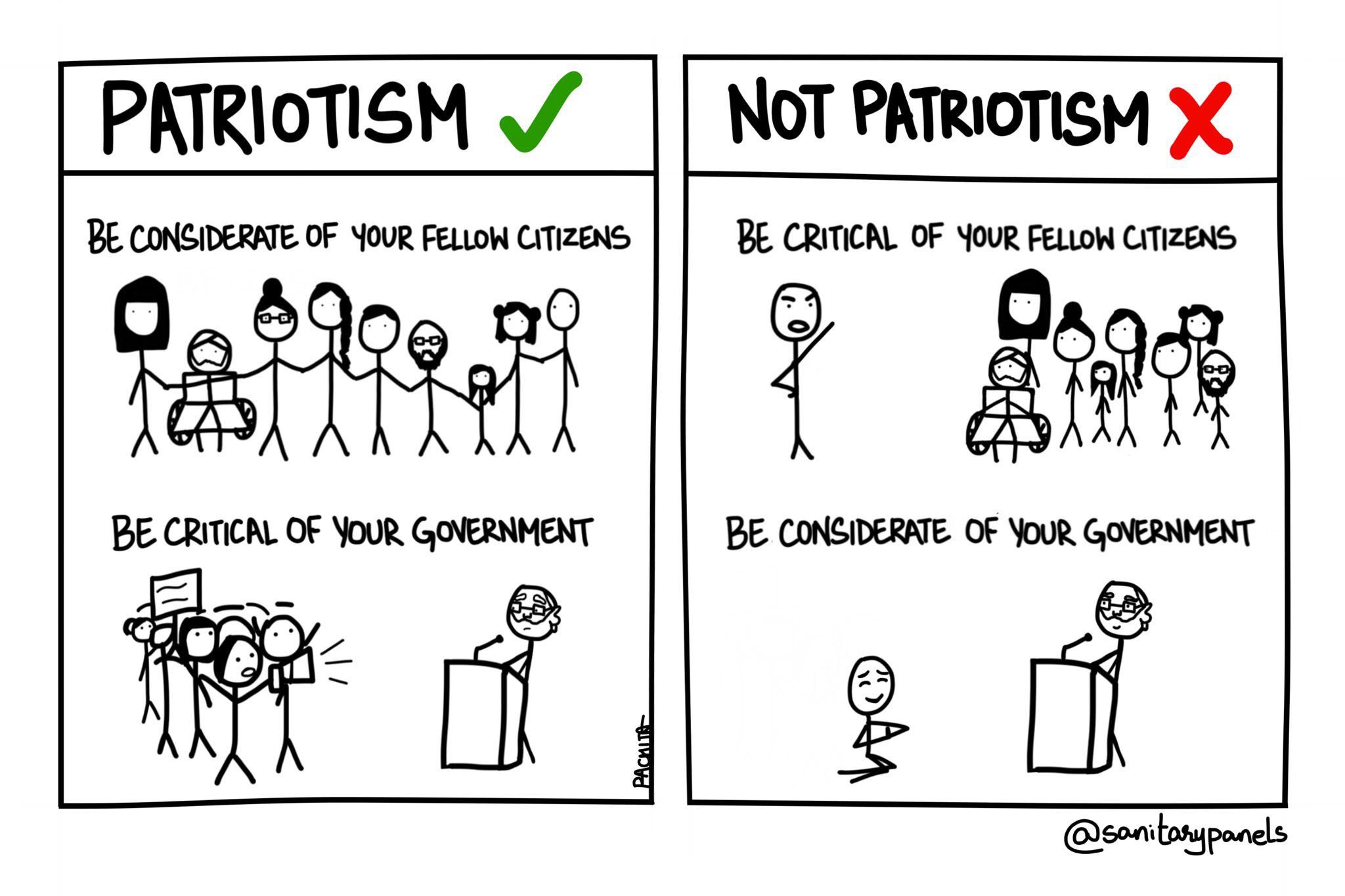
<div class="imagecaption"><a href="https://www.instagram.com/p/CCTGHChpkcQ"/><img src="https://arnabocean.com/images/posts/patriotismcomic.jpg" alt="Patriotism Comic" width="500px" position="middle"/></a>

<p>Comic by <a href="https://www.instagram.com/sanitarypanels"/>@SanitaryPanels</a>.</p>
</div>

<p>We are as yet a young democracy. It hasn&#8217;t been long enough for us as a country to forget what it took to gain independence. It hasn&#8217;t been long enough for us to forget, or worse—ignore, the principles and ideas on which India was founded. We are a unique, complex, multi-cultural, blended pool of humanity, requiring active effort to build and keep harmony. If we are to be <em>united</em>, we have to refrain from being communal, we have to <em>resist</em> our entrenched judgments of our neighbors, we have to <em>rise up</em> in support of those who cannot speak for&nbsp;themselves.</p>
<p>Usually, we are supposed to look to our government, <em>as our representatives</em>, to uphold these values, and hold us together as a nation. If — when — they fail to do so, it is up to us to unite, resist, and rise up <em>against</em> the government&nbsp;too.</p>]]></content>
        <categories><category><![CDATA[Articles]]></category><category><![CDATA[politics]]></category><category><![CDATA[democracy]]></category><category><![CDATA[India]]></category></categories>
    </entry>
    <entry>
        <id>https://arnabocean.com/frontposts/2020-08-03-evolution-grandmothers/</id>        
        <updated>2020-08-03 00:00:00-04:00</updated>
        <title type="html"><![CDATA[☞ Human evolution and the role of our&nbsp;grandmothers]]></title>
        <link href="https://www.npr.org/sections/goatsandsoda/2018/06/07/617097908/why-grandmothers-may-hold-the-key-to-human-evolution"/>
        <content type="html"><![CDATA[<p>From the archives, this article from <span class="caps">NPR</span> sheds fascinating light on the role of our grandmothers in human evolution. For example, <a href="https://faculty.utah.edu/u0030555-KRISTEN_HAWKES/research/index.hml">Dr. Kristen Hawkes</a> at the University of Utah follows modern hunter-gatherer tribes to understand how our ancestors might have&nbsp;lived.</p>
<blockquote>
<p>Over many extended field visits, Hawkes and her colleagues kept track of how much food a wide sample of Hadza community members were bringing home. She says that when they tracked the success rates of individual men, &#8220;they almost always failed to get a big animal.&#8221; They found that the average hunter went out pretty much every day and was successful on exactly 3.4 percent of those excursions. That meant that, in this society at least, the hunting hypothesis seemed way off the mark. If people here were depending on wild meat to survive, they would&nbsp;starve.</p>
<p>So if dad wasn&#8217;t bringing home the bacon, who was? After spending a lot of time with the women on their daily foraging trips, the researchers were surprised to discover that the women, both young and old, were providing the majority of calories to their families and&nbsp;group-mates.</p>
</blockquote>
<div class="imagecaption"><a href="https://media.npr.org/assets/img/2018/06/05/gettyimages-125215765-edit-edit_custom-b68b8ba94c382dc1b1df728810c4400022b7f081-s800-c85.jpg"><img src="https://arnabocean.com/images/posts/HazdaWomanDigging.jpg" alt="A Hazda woman digs for tubers with a digging stick." width="500px" position="middle"/></a>

<p>A Hazda woman digs for tubers with a digging stick. <a href="https://media.npr.org/assets/img/2018/06/05/gettyimages-125215765-edit-edit_custom-b68b8ba94c382dc1b1df728810c4400022b7f081-s800-c85.jpg">(copyright <span class="caps">NPR</span>/Nigel Pavitt/Getty Images/<span class="caps">AWL</span> Images)</a>.</p>
</div>

<p>As we learn more, we are coming to realize that our strong relations with our grandparents is not just a weird (and lucky!) quirk of our evolution, but quite necessary to our anthropological journey to our&nbsp;present.</p>
<p>For starters, not all animals have &#8216;grandparents&#8217;, i.e. &#8216;elders&#8217; living long past their reproductive age, in the first place. <a href="https://blogs.scientificamerican.com/observations/the-grandmother-factor-why-do-only-2010-06-30/">Humans (and other great apes), whales</a> and <a href="https://www.sciencedaily.com/releases/2016/01/160119141422.htm">elephants</a> are a small minority of those with societal grandparents. Even among humans, having grandparents <a href="https://www.scientificamerican.com/article/the-evolution-of-grandparents-2012-12-07/">may be a more recent development than we think</a>.</p>
<p>This <span class="caps">NPR</span> article provides a great perspective from several researchers. We were surely hunter gatherers in our evolutionary past, but it turns out that <em>how</em> our hunting and gathering occurred is way more complex than <em>the men hunted and fed their families</em>. </p>
<p>If you&#8217;re following Dr. Hawkes&#8217; work, you might be interested in <a href="https://insitome.libsyn.com/website/the-evolutionary-importance-of-mothers-and-grandmothers">this podcast</a> that she appeared on at <a href="https://insitome.libsyn.com/website">The Insight</a>.</p><p><a href="https://www.npr.org/sections/goatsandsoda/2018/06/07/617097908/why-grandmothers-may-hold-the-key-to-human-evolution">&#10166;</a> | <a rel="full-article" href="https://arnabocean.com/frontposts/2020-08-03-evolution-grandmothers/">&infin;</a></p>]]></content>
        <categories><category><![CDATA[Link-Posts]]></category><category><![CDATA[evolution]]></category><category><![CDATA[anthropology]]></category></categories>
    </entry>
    <entry>
        <id>https://arnabocean.com/frontposts/2020-06-02-elephant-torture-india/</id>        
        <updated>2020-06-02 00:00:00-04:00</updated>
        <title type="html"><![CDATA[☞ Pregnant elephant tortured to death in India: it was fed a pineapple stuffed with&nbsp;firecrackers.]]></title>
        <link href="https://www.ndtv.com/india-news/pregnant-elephant-fed-pineapple-stuffed-with-crackers-in-keralas-malappuram-she-died-standing-in-river-2239497"/>
        <content type="html"><![CDATA[<p>I am appalled to admit that <a href="https://www.ndtv.com/india-news/pregnant-elephant-fed-pineapple-stuffed-with-crackers-in-keralas-malappuram-she-died-standing-in-river-2239497">the creatures who did this</a> are of my same&nbsp;species:</p>
<blockquote>
<p>An elephant that was pregnant died in Kerala, standing in water, last Wednesday, after she faced one of the most brutal forms of animal abuse. She ate a pineapple filled with firecracker, offered to her allegedly by some locals. The fruit exploded in her mouth, leading to the inevitable&nbsp;tragedy.</p>
<p>[&#8230;]</p>
<p>So powerful was the cracker explosion in her mouth that her tongue and mouth were badly injured. The elephant walked around in the village, in searing pain and in hunger. She was unable to eat anything because of her&nbsp;injuries.</p>
</blockquote>
<p>I am more disturbed by this incident than I can put into words. Poor, poor elephant, expecting a minimum — the very minimum — of cross-species friendliness, and receiving not just death, not just agony, but excruciating, hours-long torture. The creatures that did this don’t deserve to share the Earth with&nbsp;anyone.</p>
<div class="imagecaption"><a href="https://c.ndtvimg.com/2020-06/qr1u8ki_kerala-pregnant-elephant-dies-facebook_625x300_02_June_20.jpg"><img src="https://arnabocean.com/images/posts/kerala-pregnant-elephant-dies.jpg" alt="The elephant stands in the Velliyar River." width="500px" position="middle"/></a>

<p>The elephant stood in the Velliyar river for hours, refusing help and in &#8216;searing pain&#8217;, until it died standing in the water. <a href="https://c.ndtvimg.com/2020-06/qr1u8ki_kerala-pregnant-elephant-dies-facebook_625x300_02_June_20.jpg">(via <span class="caps">NDTV</span>)</a>.</p>
</div>

<p>The news report was based on accounts from a forest officer on social media who went to respond to the situation, and has no mention of whether anyone has been arrested for this. The creatures that did this should face consequences at the very least according to the laws of their own species, surely. (That would be inadequate and the bare minimum, but the rest of us are, after all, bound by such things as codes of conduct, and laws, and&nbsp;morals.)</p>
<p>Anyway, <a href="https://indiankanoon.org/doc/3563/">this here is the relevant Indian Penal Code section</a>:</p>
<blockquote>
<p>[Section] 429. Mischief by killing or maiming cattle, etc., of any value or any animal of the value of fifty rupees.—Whoever commits mis­chief by killing, poisoning, maiming or rendering useless, any elephant, camel, horse, mule, buffalo, bull, cow or ox, whatever may be the value thereof, or any other animal of the value of fifty rupees or upwards, shall be punished with imprisonment of either description for a term which may extend to five years, or with fine, or with&nbsp;both.</p>
</blockquote>
<p>Whoever did this needs to be behind bars. Anyone that could have spoken up and didn’t needs to be behind bars too. 5 years, the penal code says. I think that’s too few; there’s no mention of torture in the code, and ‘mischief’ is quite inadequate to capture the extent of this monstrosity. Put them all in jail, and slap fines large enough that they spend the rest of their lives just paying them&nbsp;off.</p>
<p>Poor, poor&nbsp;elephant.</p><p><a href="https://www.ndtv.com/india-news/pregnant-elephant-fed-pineapple-stuffed-with-crackers-in-keralas-malappuram-she-died-standing-in-river-2239497">&#10166;</a> | <a rel="full-article" href="https://arnabocean.com/frontposts/2020-06-02-elephant-torture-india/">&infin;</a></p>]]></content>
        <categories><category><![CDATA[Link-Posts]]></category><category><![CDATA[animals]]></category><category><![CDATA[torture]]></category><category><![CDATA[inhumanity]]></category><category><![CDATA[India]]></category></categories>
    </entry>
    <entry>
        <id>https://arnabocean.com/frontposts/2019-10-14-saha-india-southafrica/</id>        
        <updated>2019-10-14 00:00:00-04:00</updated>
        <title type="html"><![CDATA[☞ Wriddhiman Saha shines as India&nbsp;wicketkeeper]]></title>
        <link href="https://www.espncricinfo.com/story/_/id/27835444/wriddhiman-saha-rare-weekend-spotlight"/>
        <content type="html"><![CDATA[<p>This makes me so happy.&nbsp;:-)</p>
<p>India wicketkeeper Wriddhiman Saha was at the very top of his game during India&#8217;s second Test cricket match against South Africa. Usually, wicket keepers are invisible when they do their job well&#8212;they&#8217;re just <em>there</em> to catch or stump the batsman out thanks to the <em>bowlers&#8217;</em> efforts. This time, though, Saha&#8217;s brilliance was plainly evident even on the highlight&nbsp;reel.</p>
<div class="imagecaption"><a href="https://engcric.b-cdn.net/wp-content/uploads/2018/06/Wriddhiman-Saha-catch-Bengaluru-AP-social.jpg"><img src="https://arnabocean.com/images/posts/Wriddhiman-Saha-catch-Bengaluru-AP-social.jpg" alt="Saha dives!" width="500px" position="middle"/></a>

<p>Saha&#8217;s keeping is a thing of beauty <a href="https://cricketaddictor.com/cricket/watch-wriddhiman-saha-takes-one-handed-blinder-to-stun-theunis-de-bruyn/">(via cricketaddictor.com)</a>.</p></div>

<p>Saha has been India&#8217;s best pure wicketkeeper for a while now. For the majority of his career he was in the shadow of the great <span class="caps">MS</span> Dhoni; more recently, Saha&#8217;s injury has allowed the precocious but evidently still raw Rishabh Pant a sniff at the top job. It&#8217;s good to finally see Saha back in action. Saha may not be as exuberant as Pant, but he can certainly bat. After this latest Test and in comparison with Pant&#8217;s work in the past year, there should be no debate at all regarding Saha&#8217;s place as India&#8217;s first choice&nbsp;keeper.</p>
<p>Welcome back, Wriddhiman! Having him behind the stumps adds beauty to the&nbsp;game.</p><p><a href="https://www.espncricinfo.com/story/_/id/27835444/wriddhiman-saha-rare-weekend-spotlight">&#10166;</a> | <a rel="full-article" href="https://arnabocean.com/frontposts/2019-10-14-saha-india-southafrica/">&infin;</a></p>]]></content>
        <categories><category><![CDATA[Link-Posts]]></category><category><![CDATA[cricket]]></category><category><![CDATA[sport]]></category><category><![CDATA[India]]></category></categories>
    </entry>
    <entry>
        <id>https://arnabocean.com/frontposts/2019-08-14-celebrating-baby-laugh/</id>        
        <updated>2019-08-14 00:00:00-04:00</updated>
        <title type="html"><![CDATA[☞ Celebrating babies&#8217; first&nbsp;laugh]]></title>
        <link href="https://www.aestheticsofjoy.com/navajo-celebration-babys-first-laugh/"/>
        <content type="html"><![CDATA[<p><a href="https://duckduckgo.com/?q=celebrating+a+baby%27s+first+laugh">There are several references to this on the internet</a>, but this is the reference that I first came across, so this is what I&#8217;m linking to. From Ingrid Fetell&nbsp;Lee:</p>
<blockquote>
<p>Did you know that the Navajo (Diné) people have a specific tradition around celebrating a baby’s first laugh? Around three months, they watch the baby closely for that first real giggle. The person who has the good fortune of eliciting that first laugh is then responsible for throwing a party, with the baby technically playing the role of host. Of course, a baby can’t host a party, so the relative or friend who coaxed out that first laugh hands out rock salt, candy, and gifts on the baby’s&nbsp;behalf. </p>
</blockquote>
<p>I love this tradition, if for nothing else then for the cuteness factor alone. There are more reasons to celebrate this event, though: laughter is a baby&#8217;s first form of communication with its surroundings and with other humans. From <a href="https://ideas.ted.com/meet-a-scientist-with-a-most-delightful-job-he-studies-baby-laughter/">this great Ted.com article</a> referencing psychology researcher Caspar&nbsp;Addyman:</p>
<blockquote>
<p>The need to communicate with laughter may have deep roots in our development as a species, speculates Addyman. Evolutionary biology suggests it’s a way for humans to share with other humans — and thus, to belong. While he is still teasing out why children needed to signal their enjoyment of the cartoon to whoever was there, he thinks it has to do with the idea, <a href="https://www.youtube.com/watch?v=7ductvdAe5s">raised by Oxford University anthropologist and primatologist Robin Dunbar</a>, that <a href="https://www.scientificamerican.com/article/with-a-little-help-from-my-friends/">laughter could be a replacement for the earlier primate behavior of grooming</a>. “Grooming was a one-on-one, unfakeable investment of time in somebody else,” explains Addyman, and it created trust among group members as well as a sense of&nbsp;community.</p>
</blockquote>
<p>We have several different baby-event celebrations; this should be one of&nbsp;them!</p><p><a href="https://www.aestheticsofjoy.com/navajo-celebration-babys-first-laugh/">&#10166;</a> | <a rel="full-article" href="https://arnabocean.com/frontposts/2019-08-14-celebrating-baby-laugh/">&infin;</a></p>]]></content>
        <categories><category><![CDATA[Link-Posts]]></category><category><![CDATA[navajo people]]></category><category><![CDATA[culture]]></category><category><![CDATA[society]]></category></categories>
    </entry>
    <entry>
        <id>https://arnabocean.com/frontposts/2018-11-01-climate-change-help-dinosaurs/</id>        
        <updated>2018-11-01 00:00:00-04:00</updated>
        <title type="html"><![CDATA[☞ The climate change that helped the&nbsp;dinosaurs]]></title>
        <link href="https://www.theatlantic.com/science/archive/2018/10/dinosaurs-dolomites/573286/"/>
        <content type="html"><![CDATA[<p>The Atlantic has an excellent piece on a drastic climate change event about 230 million years ago, when vast quantities of carbon dioxide gas erupted from undersea volcanoes. We&#8217;ve all heard the story of how the dinosaurs <em>disappeared</em>; well, this one is a different&nbsp;story.</p>
<blockquote>
<p>But perhaps the most extraordinary aspect of the Carnian Pluvial Episode was not the crisis itself, but the world that came after. Until then, dinosaurs had been a puny and obscure lineage confined to the furthest southern reaches of Pangaea. But by the time the crisis was over, they had spread all over the world—perhaps using the oddly humid pulse to hopscotch across the previously arid wastelands of Pangaea—and rapidly diversified, using the extinction of their competitors to experiment with new lifestyles. The planet would never be the&nbsp;same.</p>
</blockquote>
<p>Speaking of climate change, living in the <span class="caps">US</span> makes it pretty clear that some of us haven&#8217;t yet gotten our head around the whys, the hows, and really, the <em>necessity</em>, of caring about climate change. This is the part that we must keep reminding ourselves: it&#8217;s not that climate change destroys the Earth; far from it. The Earth was, is and will be <em>fine</em>. It&#8217;s just that the species that inhabit the Earth has and <em>will</em> change with drastic climate&nbsp;change.  </p>
<p>If we, humankind, as a species are destined to have the same fate as the dinosaurs, well, so be it. But hey, if there&#8217;s one thing us humans have done better than any other species, that&#8217;s to change our environment to suit ourselves. Let&#8217;s use that to keep Earth&#8217;s climate <em>as we like it</em>! A huge chunk of our civilization is based on proximity to water, including oceans; a huge chunk of us are used to certain weather patterns. We won&#8217;t like it if either of those factors change. <em>We won&#8217;t</em>; the Earth won&#8217;t&nbsp;care.</p>
<p>(Hopefully we won&#8217;t end up like the dinosaurs. Hopefully, we will (a) keep Earth&#8217;s climate under control, and (b) inhabit other planets, at least, by the time <a href="https://www.universetoday.com/12648/will-earth-survive-when-the-sun-becomes-a-red-giant/">the Sun makes Earth uninhabitable</a>.)</p>
<p>Anyway, go read this great article. This kind of story about the paths of life and evolution on Earth is always fascinating to&nbsp;read.</p><p><a href="https://www.theatlantic.com/science/archive/2018/10/dinosaurs-dolomites/573286/">&#10166;</a> | <a rel="full-article" href="https://arnabocean.com/frontposts/2018-11-01-climate-change-help-dinosaurs/">&infin;</a></p>]]></content>
        <categories><category><![CDATA[Link-Posts]]></category><category><![CDATA[climate change]]></category><category><![CDATA[dinosaurs]]></category><category><![CDATA[paleontology]]></category></categories>
    </entry>
    <entry>
        <id>https://arnabocean.com/frontposts/2018-10-30-bhutan-democracy-happiness/</id>        
        <updated>2018-10-30 00:00:00-04:00</updated>
        <title type="html"><![CDATA[☞ <span class="quo">&#8216;</span>Democracy brings discontent&#8217; in peaceful&nbsp;Bhutan]]></title>
        <link href="https://www.washingtonpost.com/world/asia_pacific/in-tiny-bhutan-known-for-its-pursuit-of-happiness-democracy-brings-discontent/2018/10/17/05e43118-d229-11e8-a275-81c671a50422_story.html"/>
        <content type="html"><![CDATA[<p>From Joanna Slater at the Washington Post is this excellent piece about emerging democracy in&nbsp;Bhutan:</p>
<blockquote>
<p>A small Himalayan nation wedged between India and China, Bhutan is famed for its isolated location, its stunning scenery and its devotion to the principle of “Gross National Happiness,” which seeks to balance economic growth with other forms of&nbsp;contentment.</p>
<p>Now Bhutan’s young democracy, only a decade old, just received a heady dose of the unhappiness that comes with electoral politics. In the months leading up to Thursday’s national elections, the first in five years, politicians traded insults and made extravagant promises. Social media networks lit up with unproved allegations and fearmongering about Bhutan’s role in the&nbsp;world.</p>
<p>It is enough to make some voters express a longing for the previous system — absolute monarchy under a beloved king. “I would love to go back,” said Karma Tenzin, 58, sitting in his apartment in the picturesque capital, Thimphu. “We would be more than&nbsp;happy.”</p>
</blockquote>
<p>Interesting&nbsp;tidbit:</p>
<blockquote>
<p>The way elections are structured here is atypical, too. Buddhist monks, nuns and other clergy are not allowed to vote, on the logic that they should remain outside politics. No campaigning is allowed after 6 p.m. And candidates found “defaming” their opponents or straying into certain sensitive topics — such as Bhutan’s oppressively close relationship with India — face fines or&nbsp;reprimands.</p>
</blockquote>
<p>Fines have been levied for describing political opponents as &#8220;anti-national&#8221; and &#8220;all talk and no substance&#8221;. This is such a stark contrast in tone and expectations from election campaigns in both India and <span class="caps">USA</span> that it almost seems quaint and anachronistic. Here&#8217;s to Bhutan maintaining its peacefulness and innocence as its democracy&nbsp;matures.</p>
<p>Bhutan went to the polls for its third parliamentary elections on 18 October, the day that the Washington Post piece was&nbsp;published.</p>
<p>(Well, perhaps democracy can also broach the topic of the <a href="https://www.nytimes.com/2013/06/29/opinion/bhutan-is-no-shangri-la.html">expulsion</a>, <a href="https://thediplomat.com/2016/09/bhutans-dark-secret-the-lhotshampa-expulsion/">deportation</a>, <a href="https://www.seattletimes.com/seattle-news/bhutanese-refugee-crisis-a-brief-history/">ethnic cleansing</a> of its Nepali-origin citizens. Can&#8217;t imagine that having a good bearing on the <a href="https://en.wikipedia.org/wiki/Gross_National_Happiness">Gross National Happiness</a>.)</p><p><a href="https://www.washingtonpost.com/world/asia_pacific/in-tiny-bhutan-known-for-its-pursuit-of-happiness-democracy-brings-discontent/2018/10/17/05e43118-d229-11e8-a275-81c671a50422_story.html">&#10166;</a> | <a rel="full-article" href="https://arnabocean.com/frontposts/2018-10-30-bhutan-democracy-happiness/">&infin;</a></p>]]></content>
        <categories><category><![CDATA[Link-Posts]]></category><category><![CDATA[politics]]></category><category><![CDATA[democracy]]></category><category><![CDATA[bhutan]]></category></categories>
    </entry>
    <entry>
        <id>https://arnabocean.com/frontposts/2018-08-16-fifa-ethics-corruption/</id>        
        <updated>2018-08-16 00:00:00-04:00</updated>
        <title type="html"><![CDATA[☞ <span class="caps">FIFA</span> updates its ethics code&#8230; to fight defamation, not&nbsp;corruption]]></title>
        <link href="https://apnews.com/d165d80179aa4117a260a1a5e65eafb6"/>
        <content type="html"><![CDATA[<p>From the <span class="caps">AP</span>:</p>
<blockquote>
<p><span class="caps">FIFA</span> has officially eradicated corruption. All it took was pressing the delete&nbsp;key.</p>
<p>Soccer officials and players who bother checking out the new code of ethics governing their conduct will find the word “corruption” missing. They also will discover how to avoid being banned for paying and receiving&nbsp;bribes.</p>
</blockquote>
<p>It seems that the lesson that <span class="caps">FIFA</span> took from their <a href="https://en.wikipedia.org/wiki/2015_FIFA_corruption_case">massive corruption scandal</a> is that they need to run a tighter ship in terms of <em>information</em> about the corruption getting&nbsp;out. </p>
<p>Related, they have also previously addressed racism in the sport by <a href="https://www.theguardian.com/football/2016/sep/25/fifa-anti-racism-task-force-russia-2018-world-cup">disbanding its anti-racism taskforce, declaring that it had &#8220;completely&#8221; fulfilled its mission.</a> &#8220;Completely&#8221;; meanwhile,  task force member Osasu Obayiuwana had this to&nbsp;say:</p>
<blockquote>
<p>“I wish I could say that I am shocked by the decision, but unfortunately I am not. The problem of racism in football remains a burning, very serious and topical one, which need continuous&nbsp;attention.&#8221;</p>
</blockquote>
<p>What would <em>you</em> bet that the next <span class="caps">FIFA</span> scandal won&#8217;t be too far away, however much they declare defamation of the body to be a punishable&nbsp;offense?</p><p><a href="https://apnews.com/d165d80179aa4117a260a1a5e65eafb6">&#10166;</a> | <a rel="full-article" href="https://arnabocean.com/frontposts/2018-08-16-fifa-ethics-corruption/">&infin;</a></p>]]></content>
        <categories><category><![CDATA[Link-Posts]]></category><category><![CDATA[corruption]]></category><category><![CDATA[soccer]]></category><category><![CDATA[ethics]]></category><category><![CDATA[sport]]></category></categories>
    </entry>
    <entry>
        <id>https://arnabocean.com/frontposts/2018-07-18-nobel-literature-academy-scandal/</id>        
        <updated>2018-07-18 00:00:00-04:00</updated>
        <title type="html"><![CDATA[☞ The ugly scandal that cancelled the Nobel prize in&nbsp;literature]]></title>
        <link href="https://www.theguardian.com/news/2018/jul/17/the-ugly-scandal-that-cancelled-the-nobel-prize-in-literature"/>
        <content type="html"><![CDATA[<p>From the&nbsp;Guardian:</p>
<blockquote>
<p>In the eyes of its members, there is no more important cultural institution in the world than the Swedish Academy. The members, who call themselves The Eighteen (always in capitals), are elected for life by their peers, and meet for a ritual dinner every Thursday evening at a restaurant they own in the heart of the old town in Stockholm. And once a year, at a ceremony brilliant with jewels and formality, the permanent secretary of the academy hands out the Nobel prize in literature and all the world&nbsp;applauds.</p>
<p>But this year there will be no prize and no ceremony. In November 2017, it was revealed in the Swedish press that the husband of one of the academy members had been accused of serial sexual abuse, in assaults alleged to have taken place over more than 20 years. Jean-Claude Arnault, a French photographer and cultural entrepreneur, is married to the poet and academician Katarina Frostenson. In addition to assault accusations against him, the pair are accused of misusing academy funding. Arnault has denied all accusations, and Frostenson has refused to&nbsp;comment.</p>
<p>The academy is paralysed by the scandal, which was followed by a slew of resignations and expulsions. Six of The Eighteen have withdrawn from any part in its deliberations; another two were compelled to do so. The statutes say that 12 members must be present to elect any new ones, so with only 10, no important decisions can be taken and no new members&nbsp;elected.</p>
</blockquote>
<p>What a mess this is. I&#8217;m tempted to say &#8220;you can&#8217;t make this stuff up&#8221;; would that be too&nbsp;ironical?</p><p><a href="https://www.theguardian.com/news/2018/jul/17/the-ugly-scandal-that-cancelled-the-nobel-prize-in-literature">&#10166;</a> | <a rel="full-article" href="https://arnabocean.com/frontposts/2018-07-18-nobel-literature-academy-scandal/">&infin;</a></p>]]></content>
        <categories><category><![CDATA[Link-Posts]]></category><category><![CDATA[nobel price]]></category><category><![CDATA[literature]]></category><category><![CDATA[scandal]]></category><category><![CDATA[society]]></category></categories>
    </entry>
    <entry>
        <id>https://arnabocean.com/frontposts/2018-07-11-usa-straw-history/</id>        
        <updated>2018-07-11 00:00:00-04:00</updated>
        <title type="html"><![CDATA[☞ Disposable America — A history of modern capitalism from the perspective of the straw.&nbsp;Seriously.]]></title>
        <link href="https://www.theatlantic.com/technology/archive/2018/06/disposable-america/563204/"/>
        <content type="html"><![CDATA[<p>By Alexis Madrigal for <em>The Atlantic</em>:</p>
<blockquote>
<p>The invention of American industrialism, the creation of urban life, changing gender relations, public-health reform, suburbia and its hamburger-loving teens, better living through plastics, and the financialization of the economy: The straw was there for all these things—rolled out of extrusion machines, dispensed, pushed through lids, bent, dropped into the&nbsp;abyss.</p>
<p>You can learn a lot about this country, and the dilemmas of contemporary capitalism, by taking a straw-eyed&nbsp;view.</p>
</blockquote>
<p>This is a <em>very</em> well researched article on the humble drinking straw, and its correlation with the evolving American societal outlook. The pervasiveness of the drinking straw in this society probably makes this a pretty good correlation to&nbsp;make.</p>
<p>Go read, this is quite an interesting, albeit long, read. (I did not know, for example, that the original straw was made from actual <em>straw</em>.)</p><p><a href="https://www.theatlantic.com/technology/archive/2018/06/disposable-america/563204/">&#10166;</a> | <a rel="full-article" href="https://arnabocean.com/frontposts/2018-07-11-usa-straw-history/">&infin;</a></p>]]></content>
        <categories><category><![CDATA[Link-Posts]]></category><category><![CDATA[society]]></category><category><![CDATA[technology]]></category><category><![CDATA[history]]></category><category><![CDATA[USA]]></category></categories>
    </entry>
    <entry>
        <id>https://arnabocean.com/frontposts/2018-07-02-kolkata-free-street-library/</id>        
        <updated>2018-07-02 00:00:00-04:00</updated>
        <title type="html"><![CDATA[☞ New free street library in&nbsp;Kolkata!]]></title>
        <link href="https://indianexpress.com/article/lifestyle/books/kolkata-has-a-new-library-on-the-street-street-library-5241200/"/>
        <content type="html"><![CDATA[<p>The Indian Express&nbsp;reports:</p>
<blockquote>
<p>If one gets down at Netaji Bhavan metro station and walks towards Rammohan Dutta road straight to Northern park one would stumble upon a rather curious sight. College-goers can be seen crowding the area and a familiar smell of books envelops it. Several books are exhibited in bookshelves on the footpath and it almost seems like a bookstore at first glance. This, however, is no bookstore, instead, it is an expansive library that houses books by authors ranging from popular Bengali comic books to Sidney Sheldon. The name of the place is Street&nbsp;Library.</p>
</blockquote>
<p>This is such a lovely concept. Anyone who wants to read can pick up a book and return it once they are finished. People who have books that they don&#8217;t plan on keeping can donate and improve the collection. People with organization skills and some spare time can chip in and organize the collection every once in a&nbsp;while.</p>
<p>This is an excellent program that encourages reading, sharing and selflessness. It also depends on a community working together to keep a good thing going. I wish this all the best, and really hope that there is enough community interest and investment to overcome the occasional miscreant. Although Kolkata is home to the <a href="https://en.wikipedia.org/wiki/National_Library_of_India">National Library of India</a>, and hosts <a href="https://www.google.com/search?hl=en&amp;q=kolkata%20public%20library">several other libraries</a>, they are either not free or not easily accessible for many people. Street libraries are an excellent idea for people short on time and energy but an interest to&nbsp;read.</p>
<p>If you&#8217;re in Kolkata and have some books to spare, perhaps you can consider donating to this? Or better yet, perhaps you can see if something similar can be organized in your part of the&nbsp;city?</p><p><a href="https://indianexpress.com/article/lifestyle/books/kolkata-has-a-new-library-on-the-street-street-library-5241200/">&#10166;</a> | <a rel="full-article" href="https://arnabocean.com/frontposts/2018-07-02-kolkata-free-street-library/">&infin;</a></p>]]></content>
        <categories><category><![CDATA[Link-Posts]]></category><category><![CDATA[library]]></category><category><![CDATA[reading]]></category><category><![CDATA[Kolkata]]></category><category><![CDATA[public service]]></category><category><![CDATA[India]]></category></categories>
    </entry>
    <entry>
        <id>https://arnabocean.com/frontposts/2018-06-29-india-bank-face-recognition/</id>        
        <updated>2018-06-29 00:00:00-04:00</updated>
        <title type="html"><![CDATA[☞ Indian banks contemplate &#8216;face reading&#8217; to spot doubtful loan&nbsp;seekers]]></title>
        <link href="https://timesofindia.indiatimes.com/business/india-business/banks-contemplate-face-detection-to-spot-the-next-vijay-mallya/articleshow/64789192.cms"/>
        <content type="html"><![CDATA[<p>From the Times of&nbsp;India:</p>
<blockquote>
<p>Private banks in the western coastal state [Gujarat] have approached the Gujarat Forensics Science University to prepare a facial micro-expressions manual, to train its employees in recognising doubtful high net-worth customers like fugitive liquor baron Vijay Mallya demanding&nbsp;loans.</p>
</blockquote>
<p>This is straight out of the American <span class="caps">TV</span> series <a href="https://en.wikipedia.org/wiki/Lie_to_Me">Lie to Me</a> (<a href="https://www.imdb.com/title/tt1235099/"><span class="caps">IMDB</span> Link</a>):</p>
<blockquote>
<p>In the show, Dr. Cal Lightman (Tim Roth) and his colleagues in The Lightman Group accept assignments from third parties (commonly local and federal law enforcement), and assist in investigations, reaching the truth through applied psychology: interpreting microexpressions, through the Facial Action Coding System, and body&nbsp;language.</p>
</blockquote>
<p>Have the Indian bankers in question seriously been watching too much <span class="caps">TV</span> reruns? In the show, the protagonists use micro expressions to evaluate suspects and their testimony to solve crimes. That&#8217;s <em>slightly</em> different from the real world case of deciding whether to give out large loans, no? (For context, India has had a <a href="https://www.thenewsminute.com/article/vijay-mallya-wants-come-back-india-claims-he-ready-repay-bank-loans-83706">slew</a> of <a href="https://thelogicalindian.com/news/jatin-mehta-winsome-diamonds/">recent</a> large <a href="https://www.businesstoday.in/sectors/banks/nirav-modi-case-pnb-fraud-11400-crore-scam-ed-cbi-raid/story/270708.html">loan frauds</a>.)</p>
<p>I am completely bewildered by this. If there have been some large loan frauds, shouldn&#8217;t the most important step be a complete overhaul and re-evaluation of how credit-worthiness of prospective clients is determined? In a <em>financial</em> sense? In a <em>risk assessment</em> and <em>cost-benefit analysis</em> sense? In an <em>available collateral</em> sense? Especially given that <a href="https://economictimes.indiatimes.com/industry/banking/finance/banking/nirav-modi-scam-us-court-wants-pnb-staff-probed/articleshow/64183650.cms">investigations have been called for on bank employees</a>, it has been alleged that <a href="https://economictimes.indiatimes.com/industry/banking/finance/banking/former-md-of-pnb-was-aware-of-nirav-modi-fraud-says-cbi/articleshow/64260412.cms">a bank <span class="caps">CEO</span> &#8220;failed to initiate steps&#8221; to prevent the fraud after there were red-flags</a>, and <a href="https://www.businesstoday.in/current/corporate/winsome-diamonds-case-cbi-files-chargesheet-against-3-former-canara-bank-officials/story/279706.html">bank officials have been charged</a>?</p>
<p>Do the bankers <em>really</em> believe that there is nothing to improve on their financial evaluations side and in their employee honesty side? Or is this a case of putting their head in the sand and going &#8216;la-la-la&#8217;? Are the bankers too entrenched in their current practices and workflows, don&#8217;t want to go through  the trouble &#8212; and the expense &#8212; of actually re-evaluating their own businesses, and are looking for guises to exculpate&nbsp;themselves?</p>
<p>I mean, seriously, if the banks want to go for next generation methods, <a href="https://www.techemergence.com/artificial-intelligence-applications-lending-loan-management/">artificial intelligence and machine learning</a> would be an actual avenue to explore. Examples to be found <a href="https://medium.com/henry-jia/bank-loan-default-prediction-with-machine-learning-e9336d19dffa">here</a> and <a href="https://medium.com/henry-jia/bank-loan-default-prediction-with-machine-learning-e9336d19dffa">here</a>. There are even <a href="https://www.coursera.org/lecture/ml-classification/predicting-loan-defaults-with-decision-trees-ZtvkP">courses</a> and available computer code(<a href="https://blog.riskspan.com/hands-on-machine-learning-predicting-loan-delinquency">here</a> and <a href="https://github.com/topics/loan-default-prediction">here</a>) to get people&nbsp;started!</p>
<p>Come now, bankers in question: get real and find real solutions to your real problems, and stop with the hand waving <span class="caps">TV</span>-show&nbsp;inspirations.</p><p><a href="https://timesofindia.indiatimes.com/business/india-business/banks-contemplate-face-detection-to-spot-the-next-vijay-mallya/articleshow/64789192.cms">&#10166;</a> | <a rel="full-article" href="https://arnabocean.com/frontposts/2018-06-29-india-bank-face-recognition/">&infin;</a></p>]]></content>
        <categories><category><![CDATA[Articles]]></category><category><![CDATA[technology]]></category><category><![CDATA[banking]]></category><category><![CDATA[fraud]]></category><category><![CDATA[crazy town]]></category><category><![CDATA[India]]></category></categories>
    </entry>
    <entry>
        <id>https://arnabocean.com/frontposts/2018-06-06-indian-rail-baggage-limit/</id>        
        <updated>2018-06-06 00:00:00-04:00</updated>
        <title type="html"><![CDATA[☞ Indian Railways decides to enforce baggage&nbsp;limits]]></title>
        <link href="https://timesofindia.indiatimes.com/business/india-business/now-rail-passengers-to-pay-six-time-penalty-for-carrying-excess-luggage/articleshow/64466451.cms"/>
        <content type="html"><![CDATA[<p>The Times of India&nbsp;reports:</p>
<blockquote>
<p>As a result of numerous complaints regarding excess baggage being towed into train compartments, the Indian Railways has decided to strictly enforce its over-three-decades-old baggage allowance rules, which will see passengers paying up to six times the stipulated amount as penalty, if caught travelling with overweight luggage, an official said&nbsp;today.</p>
</blockquote>
<p>I never even knew that these baggage rules existed. All these years, I&#8217;ve simply assumed that there were no formal baggage limits; that space constraints and being reasonable to fellow passengers is all that stops people from carrying waaay too much stuff with them on to trains. Unfortunately, people often <em>do</em> carry too much stuff with them, and to the level of straining and breaking limits of&nbsp;reason.</p>
<p>Which is why the rule enforcement itself, to me, is entirely justified. Even in the little travel that I have done via Indian Railways in the recent past, people carrying way too much luggage, both in quantity and physical size, is way too common for&nbsp;comfort.</p>
<p>The important question, though, is how much luggage is allowed? After all, the railways is used in a vast majority by people for whom expense is a major&nbsp;factor.</p>
<blockquote>
<p>According to the prescribed norms, a sleeper class and a second class passenger can carry luggage weighing 40 kg and 35 kg respectively without paying any extra money and a maximum of 80 kg and 70 kg respectively by paying for the excess luggage at the parcel office. The excess luggage would have to be put in the luggage&nbsp;van.</p>
<p>[&#8230;]</p>
<p>For example, if a passenger is travelling 500 km with luggage weighing 80 kg in the sleeper class, he can book his excess baggage of 40 kg for Rs 109 in the luggage&nbsp;van.</p>
<p>[&#8230;]</p>
<p>Similarly, an <span class="caps">AC</span> first class passenger can carry 70 kg of luggage for free and a maximum of 150 kg, after paying a fee for the excess 80&nbsp;kg.</p>
<p>An <span class="caps">AC</span> two-tier passenger can carry 50 kg of luggage for free and a maximum of 100 kg by paying a fee for the excess 50&nbsp;kg.</p>
</blockquote>
<p>Only 35-40kg for the second class passenger? That seems a little on the lower side. Barely a couple of suitcases, perhaps? In our international travel to and from the <span class="caps">USA</span> we&#8217;re allowed 46kg in two checked in suitcases, along with additional cabin baggage; surely a railway compartment should be able to accommodate more per passenger? The limits for the <span class="caps">AC</span> classes seem a little more reasonable, but still low considering that fewer passengers occupy the same compartment&nbsp;area.</p>
<p>The cost for extra baggage doesn&#8217;t seem too bad either. About Rs. 100 for essentially doubling the baggage allowance is hopefully okay, considering prices of other commodities, although I hope the baggage charges increase with the class of tickets. The cheapest tickets should really also have the cheapest excess baggage charges, considering the budget conscious&nbsp;traveler.</p>
<p>I&#8217;m most concerned, though, with two things. One, the excess luggage is to be placed in a separate luggage van. (Come to think of it, I&#8217;ve always known these luggage vans exist on trains. I always assumed they were for freight or oversized luggage. Huh.) I&#8217;m guessing the luggage van is perfectly safe with no fear of theft, but I&#8217;m also certain many, many passengers will take a long time to be comfortable with the idea of their bags not being right next to them. (Although, side benefit: if the bags aren&#8217;t just lying around in the compartment, they&#8217;re <em>safer</em> from&nbsp;theft.)</p>
<p>Two, they say they will &#8220;enforce&#8221; the law by random checks. This is bad, especially in India, where: (a) this situation is ripe with bribing opportunities, and (b) random checking introduces the concept of fairness between travelers who got caught and who didn&#8217;t. I really hope they figure out a more robust way of executing&nbsp;this.</p>
<p>In concept, the baggage allowance idea seems reasonable, but I hope they do a good job of the current idea, and I really hope they revisit the current ideas and update them based on feedback and usage data. The Indian Railways is a lifeline in India, and things like this can have a major effect either&nbsp;way.</p><p><a href="https://timesofindia.indiatimes.com/business/india-business/now-rail-passengers-to-pay-six-time-penalty-for-carrying-excess-luggage/articleshow/64466451.cms">&#10166;</a> | <a rel="full-article" href="https://arnabocean.com/frontposts/2018-06-06-indian-rail-baggage-limit/">&infin;</a></p>]]></content>
        <categories><category><![CDATA[Articles]]></category><category><![CDATA[travel]]></category><category><![CDATA[railways]]></category><category><![CDATA[india]]></category></categories>
    </entry>
    <entry>
        <id>https://arnabocean.com/frontposts/2017-12-15-ariane5-crash-bug/</id>        
        <updated>2017-12-15 00:00:00-05:00</updated>
        <title type="html"><![CDATA[☞ How the smallest programming bugs can be&nbsp;catastrophic]]></title>
        <link href="https://around.com/ariane.html"/>
        <content type="html"><![CDATA[<p>From way back in&nbsp;1996:</p>
<blockquote>
<p>It took the European Space Agency 10 years and $7 billion to produce Ariane 5, a giant rocket capable of hurling a pair of three-ton satellites into orbit with each launch and intended to give Europe overwhelming supremacy in the commercial space&nbsp;business.</p>
<p>All it took to explode that rocket less than a minute into its maiden voyage last June, scattering fiery rubble across the mangrove swamps of French Guiana, was a small computer program trying to stuff a 64-bit number into a 16-bit&nbsp;space.</p>
<p>One bug, one crash. Of all the careless lines of code recorded in the annals of computer science, this one may stand as the most devastatingly&nbsp;efficient.</p>
</blockquote>
<p>More links <a href="http://www-users.math.umn.edu/~arnold/disasters/ariane.html">here</a>, and the report of the inquiry into the incident is <a href="http://www-users.math.umn.edu/~arnold/disasters/ariane5rep.html">archived here</a>.</p>
<p>A fascinating, and from a programmer&#8217;s perspective chilling, read. This is the stuff of nightmares — an apparently innocuous line of code causing an exception that leads to&nbsp;disaster!</p><p><a href="https://around.com/ariane.html">&#10166;</a> | <a rel="full-article" href="https://arnabocean.com/frontposts/2017-12-15-ariane5-crash-bug/">&infin;</a></p>]]></content>
        <categories><category><![CDATA[Link-Posts]]></category><category><![CDATA[programming]]></category><category><![CDATA[spaceflight]]></category></categories>
    </entry>
    <entry>
        <id>https://arnabocean.com/frontposts/2017-12-11-adios-cassini/</id>        
        <updated>2017-12-12 00:00:00-05:00</updated>
        <title type="html"><![CDATA[Adios&nbsp;Cassini]]></title>
        <link href="https://arnabocean.com/frontposts/2017-12-11-adios-cassini/"/>
        <content type="html"><![CDATA[<p>A couple of months ago, 15 September to be precise, marked the end of an era in the human exploration of our solar system. The Cassini spacecraft was programmed to crash into Saturn’s upper atmosphere and burn up, thus ending an almost two-decade journey and exploration of Saturn and its moons. I was in middle school when this mission launched in 1997, and at that point, even reaching Saturn in 2004 seemed eons away. Twenty years later, perhaps it’s time to look back at some of the amazing insights we’ve&nbsp;gained.</p>
<p>Cassini is actually a shortened name for the <a href="https://en.wikipedia.org/wiki/Cassini–Huygens">Cassini-Huygens mission</a>, and comprises the main spacecraft — Cassini — designed to travel as a satellite in the Saturn planetary system, and a small lander — <a href="https://en.wikipedia.org/wiki/Huygens_(spacecraft)">Huygens</a> — designed to actually land on <a href="https://en.wikipedia.org/wiki/Titan_(moon)">Titan</a>, Saturn’s largest&nbsp;moon. </p>
<p><a href="https://en.wikipedia.org/wiki/Giovanni_Domenico_Cassini">Giovanni Cassini</a> was an Italian mathematician and astronomer, and discovered four of Saturn’s moons — Iapetus, Rhea, Tethys and Dione. The Cassini spacecraft was the first to observe all four of these moons. <a href="https://en.wikipedia.org/wiki/Christiaan_Huygens">Christiaan Huygens</a> was, of course, a famous Dutch astronomer and scientist, and discovered — but of course — Titan, then the first known moon of Saturn. (He also invented the pendulum clock, was mentor to Gottfried Leibniz, studied optics and the wave nature of light, and derived the modern formula for centripetal&nbsp;force.)</p>
<div class="imagecaption"><a href="https://en.wikipedia.org/wiki/File:8423_20181_1saturn2016.jpg"><img src="https://arnabocean.com/images/posts/adios-cassini/8423_20181_1saturn2016.jpg" alt="Saturn by Cassini" width="500px" position="middle"/></a>

<p>Saturn by Cassini <a href="https://en.wikipedia.org/wiki/File:8423_20181_1saturn2016.jpg">(via Wikipedia)</a>.</p></div>

<p>Of the <a href="https://saturn.jpl.nasa.gov/">many discoveries made by Cassini</a>, I’ll focus on just two stories: those of Saturn’s largest moon Titan, and Saturn’s hexagon. Both of these fascinate me to no end, and I think reflect the best of Cassini’s&nbsp;contributions.</p>
<!--more-->

<h2 id="saturns-polar-hexagon">Saturn's Polar Hexagon</h2>
<p>Jupiter is famous for its Great Red Spot; Saturn has its own atmospheric phenomenon that’s equally fascinating. <a href="https://en.wikipedia.org/wiki/Saturn%27s_hexagon">Saturn’s Hexagon</a> was first discovered by the <a href="https://en.wikipedia.org/wiki/Voyager_program">Voyager missions</a>, but now Cassini has had the chance to see it from up&nbsp;close.</p>
<p>Technically, the Hexagon is a persisting cloud pattern formed by jet streams around Saturn’s north pole, but its sheer size and perfect symmetry make it unique. Each side of the hexagon is about 13800km long (to compare, Earth’s diameter is about 12700km), and its winds travel at around 300km/h. It’s been there since the Voyager missions in the 1980s, so we know its&nbsp;long-lived. </p>
<div class="imagecaption"><a href="https://en.wikipedia.org/wiki/File:PIA18274-Saturn-NorthPolarHexagon-Cassini-20140402.jpg"><img src="https://arnabocean.com/images/posts/adios-cassini/PIA18274-Saturn-NorthPolarHexagon-Cassini-20140402.jpg" alt="Saturn - North polar hexagon and vortex as well as rings (April 2, 2014)" width="400px" position="middle"/></a>

<p>Saturn - North polar hexagon and vortex as well as rings (April 2, 2014) <a href="https://en.wikipedia.org/wiki/File:PIA18274-Saturn-NorthPolarHexagon-Cassini-20140402.jpg">(via Wikipedia)</a>.</p></div>

<p>On Earth, our jet streams are forced to bend and move in response to Earth’s surface features such as mountains. Saturn is much larger than Earth (Saturn diameter is about 116000km) but has a rocky core that’s similar in size to Earth, and so its jet streams have no such problems, and can keep flowing in their own orderly and symmetrical&nbsp;fashion.</p>
<p>The hexagon is essentially a quirk of fluid mechanics. Here on Earth, scientists have been able to create (<a href="https://doi.org/10.1016%2Fj.icarus.2009.10.022">here</a>, and <a href="https://doi.org/10.1016/j.icarus.2009.10.022">here</a>) such regular shapes by rotating a circular tank of liquid at different speeds at its center and outer edge. Due to the difference in speeds, a turbulent region is created where such regular shapes can be observed. The regular shape is not always a hexagon (shapes with three to eight sides, i.e. from a triangle to an octagon, are produced) but a hexagon is the most commonly occurring. However, the phenomenon only occurs when the speed differential and fluid properties fall under certain small margins, and therefore the hexagon phenomenon is not observed everywhere where its possible (such as Jupiter, or even the south pole of&nbsp;Saturn).</p>
<p>At the center of the Hexagon, right at the north pole, is a humongous storm, with a definite and easily observed eye wall. The south pole has such a storm as well, although it doesn’t display a Hexagon. In each case, the eye of the storm is about 50 times wider than a hurricane would be on&nbsp;Earth.</p>
<p>As much as the Hexagon is an atmospheric and scientific phenomenon, explained and replicated under lab conditions, it’s one of our solar system’s most beautiful sights, and something I’ll keep looking for in photos of Saturn, now that I know it’s&nbsp;there.</p>
<div class="imagecaption"><a href="https://www.jpl.nasa.gov/spaceimages/details.php?id=PIA14946"><img src="https://arnabocean.com/images/posts/adios-cassini/saturn-polar-hexagon-color.jpg" alt="False color image of storms at Saturn's north pole" width="400px" position="middle"/></a>

<p>False color image of storms at Saturn&#8217;s north pole <a href="https://www.jpl.nasa.gov/spaceimages/details.php?id=PIA14946">(via <span class="caps">JPL</span>/<span class="caps">NASA</span>)</a>.</p></div>

<h2 id="titan">Titan</h2>
<p><a href="https://en.wikipedia.org/wiki/Titan_(moon)">Titan</a> is Saturn’s largest moon, and of special interest to us: Titan is the only known moon with an atmosphere, and the only one other than Earth whose atmosphere is majority nitrogen. Moreover, its atmosphere is denser and more massive than ours, and is opaque at many wavelengths of light. This means that, like Venus, we had no idea of what the surface of Titan looks like until we had a probe that could land on the surface of Titan. Thanks to Cassini and Huygens, we know a lot more today about Titan than we did in&nbsp;2004.</p>
<p>Titan, we know now, has an active weather system, including wind and liquid rain, just like on Earth. Of course, the liquid that rains is different from Earth: it rains liquid methane on Titan. Nevertheless, its nitrogen atmosphere and presence of liquids means that Titan’s methane cycle is analogous to Earth’s water cycle. Titan&#8217;s upper atmosphere is also affected by ultraviolet light from the Sun, whereby atmospheric methane is broken down and reconstituted into a diverse mix of complex&nbsp;hydrocarbons.</p>
<p>We’re not done yet with the comparisons with Earth! <a href="https://en.wikipedia.org/wiki/Lakes_of_Titan">Titan has lakes and oceans</a>, comprised of methane, ethane, and dissolved nitrogen; this makes Titan only the second object in the Solar System (after Earth) to have stable liquids present at ambient temperatures. It most likely also has volcanoes, and is affected by tidal effects from Saturn’s massive gravity. Titan’s surface, specifically where Huygens landed, looks uncannily like Earth, with ‘globules’ about 10-15cm in size, made probably of water&nbsp;ice.</p>
<div class="imagecaption"><a href="https://en.wikipedia.org/wiki/File:Huygens_surface_color.jpg"><img src="https://arnabocean.com/images/posts/adios-cassini/Huygens_surface_color.jpg" alt="Huygens' view of Titan's surface" width="200px" position="middle"/></a>

<p>Huygens&#8217; view of Titan&#8217;s surface <a href="https://en.wikipedia.org/wiki/File:Huygens_surface_color.jpg">(via Wikipedia)</a>.</p></div>

<p>It’s almost as if Titan is an analogue of Earth— only much colder. In fact, in very specific ways it’s not even colder by much thanks to Titan’s greenhouse effect and tidal heating from Saturn. Cassini has performed numerous gravity measurements of Titan, which reveal that there is a hidden, internal, ocean of liquid water and ammonia beneath Titan’s&nbsp;surface.</p>
<p>So, to summarize, Titan has: an active weather system, large quantities of complex hydrocarbons (Titan is much, much richer in hydrocarbons than Earth), tidal effects from Saturn, and interaction of its atmospheric methane with ultraviolet radiation from the Sun, and even and underground ocean of liquid water and ammonia. A question is begging to be asked at this point: what are the chances of life (past, present or future) on&nbsp;Titan?</p>
<p>Scientists think Titan definitely has the potential to contain habitable environments. Similar to Earth in its infancy, Titan today has the pieces needed for new life to possibly form. Whether it already has, or the extent of future possibility, can only be understood with even better exploration. Indeed, quite a few ideas for future missions dedicated to Titan have been proposed, but none have really gotten off the ground (pun intended)&nbsp;yet.</p>
<p>The most promising of them all is a design to send a submarine to Titan that can explore the seas of Titan, but even this idea is in relatively early&nbsp;stages.</p>
<h2 id="so-much-more">So Much More...</h2>
<p>I’ve really just scratched the surface here of how much the Cassini mission gleaned from the Saturn system. There’s so much more: Saturn’s rings and their composition; the moon Enceladus and its jets of icy particles and subsurface ocean of salty water; the moon Iapetus and its equatorial ridge; the moon Mimas and its crater that gives it the Death Star look… trust me, if you don’t take an interest yet, you will once you start&nbsp;reading.</p>
<p>The Cassini-Huygens mission really gave us glimpses into a planetary system that provides great opportunities for scientific discovery, amazing new and diverse worlds, and even — dare we dream? — possibilities of places that can harbor&nbsp;life.</p>
<p>It’s time to say adios to Cassini, but of course, we humans have a long way to go before we can say we know our own solar&nbsp;system.</p>
<div class="imagecaption"><a href="https://en.wikipedia.org/wiki/Mimas_(moon)#/media/File:Mimas_Cassini.jpg"><img src="https://arnabocean.com/images/posts/adios-cassini/Mimas_Cassini.jpg" alt="Saturn's moon Mimas, with the crater Herschel visible prominently" width="400px" position="middle"/></a>

<p>Saturn&#8217;s moon Mimas, with the crater Herschel visible prominently <a href="https://en.wikipedia.org/wiki/Mimas_(moon)#/media/File:Mimas_Cassini.jpg">(via Wikipedia)</a>.</p></div>

<p><em>(This piece first appeared in the 2017 edition of <a href="https://indd.adobe.com/view/a0fd6c1d-7057-486b-904f-5d7eb1e26247">Sharod Sombhar</a>, an annual magazine from the <a href="http://www.bengali.org.vt.edu">Bengali Students’ Association at Virginia Tech</a>.)</em></p>]]></content>
        <categories><category><![CDATA[Articles]]></category><category><![CDATA[astronomy]]></category><category><![CDATA[space]]></category><category><![CDATA[science]]></category><category><![CDATA[space travel]]></category></categories>
    </entry>
    <entry>
        <id>https://arnabocean.com/frontposts/2017-09-19-india-highspeed-rail/</id>        
        <updated>2017-09-18 00:00:00-04:00</updated>
        <title type="html"><![CDATA[Of India&#8217;s high-speed rail ambitions, and lazy Indian&nbsp;journalism]]></title>
        <link href="https://arnabocean.com/frontposts/2017-09-19-india-highspeed-rail/"/>
        <content type="html"><![CDATA[<p>India&#8217;s plans about building a high speed rail route connecting Mumbai and Ahmedabad <a href="http://indianexpress.com/article/india/india-news-india/mumbai-ahmedabad-bullet-train-will-need-to-make-100-trips-a-day-to-be-viable-iim-study/">have</a> <a href="http://www.dnaindia.com/business/report-for-a-successful-run-ahmedabad-mumbai-bullet-train-should-have-at-least-100-trips-in-1-day-says-iim-ahmedabad-study-2546739">been</a> in the <a href="http://indiatoday.intoday.in/story/bullet-train-will-need-100-trips-daily-to-be-financially-viable-iim-ahmedabad-study/1/645171.html">news</a> <a href="http://www.timesnownews.com/business-economy/article/mumbai-ahmedabad-bullet-train-will-need-100-trips-daily-to-be-financially-viable-iim-ahmedabad-study/92862">lately</a>. The project is funded by a low-interest loan from Japan (covering 80% of the cost of the project), and will make use of Japanese high-speed rail technology used for the <a href="https://en.wikipedia.org/wiki/Shinkansen">Shinkansen</a>.</p>
<p>Of course, along with the project being in the news, it is also subject to <a href="http://www.businesstoday.in/current/economy-politics/mumbai-ahmedabad-bullet-train-cost-japan-india/story/260280.html">critique</a> in news articles, as any expensive government venture is bound to (and should!) be. In many of the articles, though, I found one common piece of information mentioned over and&nbsp;over:</p>
<blockquote>
<p>According to a study conducted by <span class="caps">IIM</span> Ahmedabad, Ahmedabad-Mumbai bullet train will need to make 100 trips daily and carry 88,000-118,000 passengers per day to be financially viable. This figure could well be way above the total number of passengers travelling between the two cities on any given&nbsp;day.</p>
</blockquote>
<p>In fact, <a href="https://encrypted.google.com/search?hl=en&amp;q=%22Dedicated%20High%20Speed%20Railway%20(HSR)%20Networks%20in%20India%3A%20Issues%20in%20Development%22">searching the internet</a> with the name of the article in question (<em>Dedicated High Speed Railway (<span class="caps">HSR</span>) Networks in India: Issues in Development</em>) provides a result that looks like&nbsp;this:</p>
<div class="imagecaption"><a href="https://encrypted.google.com/search?hl=en&q=%22Dedicated%20High%20Speed%20Railway%20(HSR)%20Networks%20in%20India%3A%20Issues%20in%20Development%22"><img src="https://arnabocean.com/images/posts/HighSpeedRailGoogleSearch.png" alt="Google Search Result" width="400px" position="middle"/></a>

<p>Google Search Result. <a href="https://encrypted.google.com/search?hl=en&q=%22Dedicated%20High%20Speed%20Railway%20(HSR)%20Networks%20in%20India%3A%20Issues%20in%20Development%22">(Source)</a></p></div>

<p>They all mention the same report, and all mention the exact same language about &#8220;requiring 100 trips a day&#8221;. None, however, actually provide links for the curious reader, nor provide any context or analysis. Well, I <em>was</em> curious, so I tried to find and read the actual&nbsp;report.</p>
<!--more-->

<p><a href="http://www.iimapr.com/article/view-article/dedicated-high-speed-rail-network-in-india-issues-in-development">This is the the report I found online.</a> It&#8217;s co-authored by Prof. G. Raghuram as mentioned in all the newspaper reports, and calls itself &#8220;an abridged version of an <a href="http://www.iimahd.ernet.in/assets/snippets/workingpaperpdf/3022551392016-03-58.pdf"><span class="caps">IIMA</span> working paper</a> with the same title.&#8221; Unfortunately, the <span class="caps">IIMA</span> working paper link is broken, and the <a href="http://web.archive.org/">Wayback Machine</a> doesn&#8217;t have it archived either. (<strong>P.S.:</strong> Between the time that I found and read the report, and I finished writing this piece, the webpage hosting the report seems to have gone dead. No matter, <a href="http://web.archive.org/web/20161024100307/http://www.iimapr.com/article/view-article/dedicated-high-speed-rail-network-in-india-issues-in-development">the Wayback Machine has it cached</a>. Go&nbsp;read!)</p>
<p>Anyhow, the report is a great read. After reading it, though, I was <a href="http://blog.arnabocean.com/post/117262067032/cities-in-west-bengal-not-being-renamed">reminded</a> of how poor India&#8217;s average journalism has come to be. What every news article printed is actually in the report being cited, and yet — and yet! — what they printed is a complete misrepresentation of the entire point and view of the&nbsp;report.</p>
<p>Let&#8217;s start with the conclusions of the report. The following are direct quotes from the Conclusions&nbsp;section:</p>
<ul>
<li>Given that India is a developing country, the primary concern is whether the funds for such a project could be better utilised in other domains, including in upgrading conventional rail. However, the Japanese funding to the tune of 80% of the project cost may not be available for other&nbsp;uses.</li>
<li>there are many positive benefits and externalities of the <span class="caps">HSR</span> which would be useful in India’s overall aspirational development. These externalities include technology percolation into other domains, economic development, game-changing sense of connectivity, and national pride due to cutting-edge infrastructure. In such a context, it is a good idea to begin and&nbsp;learn.</li>
<li>The Mumbai-Ahmedabad route is a good choice for the first route, since it connects India’s first and seventh most populous cities, with significant economic development in the 500 km corridor between&nbsp;them.</li>
<li>The low cost Japanese financing has been a great catalyst. Though it is a tied funding with significant mandatory procurement from Japan, it cannot do much harm since Japan is at the cutting edge of <span class="caps">HSR</span> technology with over 50 years of&nbsp;experience.</li>
</ul>
<p>Evidently, the overarching view of the article is <em>not</em> that &#8220;100 trips will be needed per day&#8230;&#8221;. Let&#8217;s talk about that part next, then. Here&#8217;s the crucial paragraph from the&nbsp;article:</p>
<blockquote>
<p>Assuming that 20% (apart from the 80% Japanese funding at concessional rates) of the total cost of the Mumbai-Ahmedabad route would be funded by the Government of India (GoI) with an expected 8% annual return during the operational phase, the estimated daily financing costs for the route would be <span class="caps">INR</span> 106 million from when the repayment of the loan kicks in. We take this to be the 16th year (till when the Japanese loan has a moratorium), by when the ramp-up of traffic should have occurred. The project cost includes the ‘interest during construction’ for seven years. Over the remaining eight ramp-up years, we assume that there would be enough operating surplus to cover the interest payments. Subsequent to this, the GoI portion is treated as an equity with only interest due, but no principal repayment. Taking an average fare of <span class="caps">INR</span> 5.00 per km for the route with intermediate stops and for a scenario of 0.4 operating ratio, we arrive at a daily required ridership of 118,000 passengers (which translates to 43 million passengers annually). At an average of 1000 passengers per train, over 100 services per day (50 per direction) would be&nbsp;required. </p>
</blockquote>
<p>What this means is that <em>if</em> the financing for the rail route is to be paid from the revenue from the rail route <em>only</em>, then about 118000 passengers, at an average of 1000 per train, over 100 services daily, would need to travel on the route. The newspaper articles only mention the raw number, with a vague notion that this is impractical or impossible to achieve. Two points should be considered, though. <strong>First</strong>, perhaps it isn&#8217;t <em>necessary</em> that revenue from the rail route matches the required financing. Perhaps the government can pay for the financing in the short term, and accrue revenue from the rail route to replenish its coffers in the longer term. <strong>Second</strong>, what is the context for the &#8220;1000 per train, 100 services daily&#8221; figure? How does it compare to other high speed rail systems in other&nbsp;countries?</p>
<p>Considering the second point first, here is literally the very next paragraph in the&nbsp;report:</p>
<blockquote>
<p>The feasibility report estimates for 2033 with a train configuration of 10/16 cars (750/1200 seats) require 52 trains per day per direction. As of 2016, some of the high-traffic <span class="caps">HSR</span> routes like Paris-Lyon (409 km), Shanghai-Nanjing (311 km) and Tokyo-Shin Osaka (552 km), though being parts of bigger networks themselves, have more than 85, 300 and 330 trains respectively running every&nbsp;day.</p>
</blockquote>
<p>Well, then! In context, the &#8220;100 trains per day&#8221; number doesn&#8217;t look so bad, does it? Considering this information, perhaps the first point above regarding financing isn&#8217;t that big a concern, either? It would seem so from the report, since it makes no further comment regarding this matter, including in its&nbsp;conclusions.</p>
<p>There are other points that the news articles mention, such as the 500km distance of the route, as being detrimental to the success of the project (&#8220;Flights only take one hour!&#8221;). Even those points are considered and answered in the report. The report really is worth the&nbsp;read.</p>
<p>—</p>
<p>The pros and cons of a large, time-consuming, and expensive government project <em>should</em> be debated — ernestly. However, the debate is derailed (forgive the pun) right at the beginning if the information being circulated is incomplete, or worse, plain wrong. Please, by all means, have the debate. Would everyone at least read the report that everyone is attempting to&nbsp;cite?</p>
<p><strong>P.S.:</strong> Between the time that I found and read the report, and I finished writing this piece, the webpage hosting the report seems to have gone dead. No matter, <a href="http://web.archive.org/web/20161024100307/http://www.iimapr.com/article/view-article/dedicated-high-speed-rail-network-in-india-issues-in-development">the Wayback Machine has it cached</a>. Go&nbsp;read! </p>]]></content>
        <categories><category><![CDATA[Articles]]></category><category><![CDATA[railways]]></category><category><![CDATA[journalism]]></category><category><![CDATA[economy]]></category><category><![CDATA[japan]]></category><category><![CDATA[india]]></category></categories>
    </entry>
    <entry>
        <id>https://arnabocean.com/frontposts/2017-06-14-radiolab-alzheimers-light/</id>        
        <updated>2017-06-14 00:00:00-04:00</updated>
        <title type="html"><![CDATA[☞ Radiolab Podcast: Using flickering lights to treat Alzheimer&#8217;s&nbsp;Disease]]></title>
        <link href="http://www.radiolab.org/story/bringing-gamma-back/"/>
        <content type="html"><![CDATA[<blockquote>
<p>Today, a startling new discovery: prodding the brain with light, a group of scientists got an unexpected surprise &#8211; they were able to turn back on a part of the brain that had been shut down by Alzheimer’s disease. This new science is not a cure, and is far from a treatment, but it’s a finding so … simple, you won’t be able to shake it. Come join us for a lab visit, where we’ll meet some mice, stare at some light, and come face-to-face with the mystery of memory. We can promise you: by the end, you’ll never think the same way about Christmas lights&nbsp;again.</p>
</blockquote>
<p>I&#8217;ve been meaning to post about this particular episode ever since I listened to it. <a href="http://nature.com/articles/doi:10.1038/nature20587">This is the Nature paper about this study.</a> They found that simply flashing light of a certain frequency at a certain interval helps with some of the brain waves that are diminished in mice with Alzheimer&#8217;s. It&#8217;s absolutely&nbsp;fascinating.</p>
<p>(I&#8217;m not going into too much technical jargon here; go listen to the&nbsp;episode!)</p>
<p>If you don&#8217;t listen to Radiolab in general, you definitely should; it&#8217;s one of the best podcasts there&nbsp;are. </p><p><a href="http://www.radiolab.org/story/bringing-gamma-back/">&#10166;</a> | <a rel="full-article" href="https://arnabocean.com/frontposts/2017-06-14-radiolab-alzheimers-light/">&infin;</a></p>]]></content>
        <categories><category><![CDATA[Link-Posts]]></category><category><![CDATA[neuroscience]]></category><category><![CDATA[disease]]></category><category><![CDATA[biology]]></category><category><![CDATA[science]]></category></categories>
    </entry>
    <entry>
        <id>https://arnabocean.com/frontposts/2017-06-13-queen-goatskin-parchment/</id>        
        <updated>2017-06-13 00:00:00-04:00</updated>
        <title type="html"><![CDATA[☞ <span class="caps">UK</span> Election: Interesting logistics of the Queen&#8217;s&nbsp;speech]]></title>
        <link href="http://www.telegraph.co.uk/news/2017/06/12/queens-speech-delayed-has-printed-goatskin-paper-takes-days/"/>
        <content type="html"><![CDATA[<p>In light of the recent <a href="http://www.cnn.com/2017/06/08/europe/uk-election-day/index.html">election in the <span class="caps">UK</span></a>, the Queen, of course, is supposed to make a speech regarding forming the government by the party that has won majority. Now, however, after the <a href="https://www.theguardian.com/politics/ng-interactive/2017/jun/08/live-uk-election-results-in-full-2017">interesting results</a> of the election, the Queen&#8217;s speech is delayed, and the reason for it is very&nbsp;interesting.</p>
<p>The Telegraph <span class="caps">UK</span>&nbsp;reports:</p>
<blockquote>
<p>The Queen’s Speech is going to be delayed because it has to be written on goatskin paper and the ink takes days to&nbsp;dry.</p>
</blockquote>
<!-- As with everything else, even normal matters take on slightly different proportions when they involve the British monarchy.  -->

<p>Apparently, the British monarchy are more concerned than others would be about the archival qualities of the paper that they&nbsp;use.  </p>
<blockquote>
<p>[&#8230;] goatskin paper is not actually made from&nbsp;goatskin.</p>
<p>The material is in fact high-quality archival paper which is guaranteed to last for at least 500&nbsp;years.</p>
</blockquote>
<p>Well, okay, but still, why the&nbsp;delay? </p>
<p>Well, ink on this special paper takes a few days to dry. And the monarchy had &#8220;ready to go&#8221; versions of the speech for (a) a Conservative party majority, and (b) a Labour party majority. But the results of the election, that <a href="https://www.theguardian.com/politics/ng-interactive/2017/jun/09/theresa-may-election-gamble-fail-conservatives-majority-polls">resulted in a hung parliament</a>, has put all pre-made plans into disarray. Since the political parties themselves don&#8217;t know yet how the government will be formed, the Queen&#8217;s speech isn&#8217;t finalized yet&nbsp;either.</p>
<blockquote>
<p>Once the details are set in stone they can be committed to the goatskin paper and sent away for binding before being presented to the&nbsp;Queen.</p>
</blockquote>
<p>I love how even the most apparently mundane things become fascinating just by being associated with the British&nbsp;monarchy.</p><p><a href="http://www.telegraph.co.uk/news/2017/06/12/queens-speech-delayed-has-printed-goatskin-paper-takes-days/">&#10166;</a> | <a rel="full-article" href="https://arnabocean.com/frontposts/2017-06-13-queen-goatskin-parchment/">&infin;</a></p>]]></content>
        <categories><category><![CDATA[Link-Posts]]></category><category><![CDATA[queen elizabeth]]></category><category><![CDATA[politics]]></category><category><![CDATA[technology]]></category><category><![CDATA[united kingdom]]></category></categories>
    </entry>
    <entry>
        <id>https://arnabocean.com/frontposts/2017-05-28-bats-communication/</id>        
        <updated>2017-05-29 00:00:00-04:00</updated>
        <title type="html"><![CDATA[☞ Everyday bat vocalizations are rich and&nbsp;complex]]></title>
        <link href="https://www.nature.com/articles/srep39419"/>
        <content type="html"><![CDATA[<blockquote>
<p>In this study, we continuously monitored Egyptian fruit bats for months, recording audio and video around-the-clock. We analyzed almost 15,000 vocalizations, which accompanied the everyday interactions of the bats, and were all directed toward specific individuals, rather than broadcast. We found that bat vocalizations carry ample information about the identity of the emitter, the context of the call, the behavioral response to the call, and even the call’s addressee. Our results underline the importance of studying the mundane, pairwise, directed, vocal interactions of&nbsp;animals.</p>
</blockquote>
<p>This is brilliant. They were able to correlate their data analysis of the bats&#8217; vocalizations with the behavior and responses that they observed&#8230; so now we know more about how bats communicate! Simply by listening to the vocalization, the context, addressee, and even &#8220;the outcome of the interaction can be predicted above chance level&#8221;.&nbsp;Fascinating.</p>
<p>From the&nbsp;discussion:</p>
<blockquote>
<p>It is important to note that we used one set of acoustic features for classification. However, many other multi-dimensional spectro-temporal representations can be tested. The bat’s brain could thus be using some other representation that encapsulates much more information regarding different social aspects. The bat may be able to classify the context of an interaction with higher confidence, based on some acoustic feature which it evolved to use and is yet to be determined. Our analysis is thus probably only a lower bound on what a bat is capable of extracting from aggressive social vocalizations. For example, we did not include any temporal information in our&nbsp;analysis. </p>
</blockquote>
<p>In any acoustic signal, and especially where communication is involved, the time parameter is usually crucial and will add rich layers of information. For example, just imagine taking a piece of human speech, and (a) only looking at the overal speech parameters, versus (b) observing how the speech parameters <em>change</em> during the speech. Case (b) will provide far more information than case (a). I think we will discover over time that bats have a pretty well-evolved communication&nbsp;scheme. </p>
<p>This is fascinating&nbsp;stuff.</p><p><a href="https://www.nature.com/articles/srep39419">&#10166;</a> | <a rel="full-article" href="https://arnabocean.com/frontposts/2017-05-28-bats-communication/">&infin;</a></p>]]></content>
        <categories><category><![CDATA[Link-Posts]]></category><category><![CDATA[animals]]></category><category><![CDATA[data analysis]]></category><category><![CDATA[biology]]></category><category><![CDATA[science]]></category></categories>
    </entry>
    <entry>
        <id>https://arnabocean.com/frontposts/2017-05-28-bayesian-intro/</id>        
        <updated>2017-05-28 00:00:00-04:00</updated>
        <title type="html"><![CDATA[☞ How Bayesian inference&nbsp;works]]></title>
        <link href="https://brohrer.github.io/how_bayesian_inference_works.html"/>
        <content type="html"><![CDATA[<blockquote>
<p>Bayesian inference is a way to get sharper predictions from your data. It’s particularly useful when you don’t have as much data as you would like and want to juice every last bit of predictive strength from&nbsp;it.</p>
<p>Although it is sometimes described with reverence, Bayesian inference isn’t magic or mystical. And even though the math under the hood can get dense, the concepts behind it are completely accessible. In brief, Bayesian inference lets you draw stronger conclusions from your data by folding in what you already know about the&nbsp;answer.</p>
</blockquote>
<p>An excellent, simple introduction to Bayesian inference. This uses practical examples and an abundance of visual guides: especially useful if you don&#8217;t have an extensive math&nbsp;background. </p><p><a href="https://brohrer.github.io/how_bayesian_inference_works.html">&#10166;</a> | <a rel="full-article" href="https://arnabocean.com/frontposts/2017-05-28-bayesian-intro/">&infin;</a></p>]]></content>
        <categories><category><![CDATA[Link-Posts]]></category><category><![CDATA[math]]></category><category><![CDATA[data analysis]]></category><category><![CDATA[tutorial]]></category><category><![CDATA[video]]></category></categories>
    </entry>
    <entry>
        <id>https://arnabocean.com/frontposts/2017-04-25-Rupam-Daniken/</id>        
        <updated>2017-04-25 00:00:00-04:00</updated>
        <title type="html"><![CDATA[Music: lyrics for Daniken, from Rupam Islam&#8217;s Notun&nbsp;Niyom]]></title>
        <link href="https://arnabocean.com/frontposts/2017-04-25-Rupam-Daniken/"/>
        <content type="html"><![CDATA[<p>Rupam Islam is out with a new solo album, <a href="https://www.youtube.com/watch?v=wBX1d-vjJ3M"><em>Notun Niyom</em></a>. Continuing with <a href="https://arnabocean.com/tag/lyrics.html">tradition</a>, here are the lyrics to <em>Daniken</em> from this album. (<em>Notun Niyom</em> is available to listen on&nbsp;Spotify!)</p>
<!--more-->

<p><strong>Song</strong>: Daniken<br>
<strong>Album</strong>: Notun&nbsp;Niyom  </p>
<p>gobeshona-tona tomake manaye<br>
amar agroho sotto&nbsp;janaye  </p>
<p>gobeshona-tona tomake manaye<br>
amar agroho sotto janaye<br>
gobeshona tumi koro e-niye<br>
phola-phol pele diyo&nbsp;janiye  </p>
<p>chola-chol kori kolpona te<br>
abhijan tai na-hanyate<br>
maddhom mon ar lekhoni<br>
lupto danar&nbsp;shonjiboni  </p>
<p>icche-ra shob kobita paray<br>
bhabchi-bhabbo gondho choray<br>
tomar icche bhobisshoter<br>
sondhan dey notun&nbsp;pother  </p>
<p>bole cholo jai se-pothe haati<br>
eta mohakash-jaaner maati<br>
control-e thak khoka-o-khuku<br>
shokti utsho&nbsp;surjo-tuku  </p>
<p>promaner tumi upashok tai<br>
amar shopne tomakei chai<br>
juktir jaale amar hridoy<br>
obohele kore nile tumi&nbsp;joy  </p>
<p>tumi ki nijeke byartho bhabo?<br>
tomake ami e-gaan shonabo<br>
aaloker goti amar gaane<br>
chhutbe notun&nbsp;surjo-taane  </p>
<p>tumi ki nijeke byartho bhabo?<br>
tomake ami e-gaan shonabo<br>
aaloker goti amar gaane<br>
chhutbe notun&nbsp;surjo-taane  </p>
<p>he-prachin, he-probin<br>
he-aadim mohakash<br>
lukiye rekhecho <br>
bhule jawa&nbsp;itihaash  </p>
<p>smriti-te tobu kaar<br>
protiddhoni shunte pai<br>
probashi aakashi<br>
se ki kono…&nbsp;debota-i?  </p>
<p>—  </p>
<p>tomar totto bhaota hole<br>
chok-choke kono rangta hole<br>
chaota-ke ami beshechi bhalo<br>
rangta amar rong&nbsp;pheralo  </p>
<p>bhaota gaiche prithibir gaan<br>
rangta ghochalo rashtro-nishan<br>
aami prothagoto dhormo-bihin<br>
aami gaai Lennon-er&nbsp;Imagine  </p>
<p>moha purushera tader juuge<br>
chole-asha rewaj-er hujuge<br>
bhondo akkha peyei thaaken<br>
Jesus Christ-o krush-e&nbsp;jhulechen  </p>
<p>ekdin tumi patta pabe<br>
tomar totto proman hobe<br>
shopno sophol hobe amar-o<br>
tokhon amay khujte&nbsp;paro  </p>
<p>ekdin tumi patta pabe<br>
tomar totto proman hobe<br>
shopno sophol hobe amar-o<br>
tokhon amay khujte&nbsp;paro  </p>
<p>he-prachin, he-probin<br>
he-aadim mohakash<br>
lukiye rekhecho <br>
bhule jawa&nbsp;itihaash  </p>
<p>smriti-te tobu kaar<br>
protiddhoni shunte pai<br>
probashi aakashi<br>
se ki kono…&nbsp;debota-i?  </p>
<p>debota-i?  </p>]]></content>
        <categories><category><![CDATA[Notes]]></category><category><![CDATA[music]]></category><category><![CDATA[lyrics]]></category><category><![CDATA[rupam islam]]></category></categories>
    </entry>
    <entry>
        <id>https://arnabocean.com/frontposts/2017-04-25-Rupam-HawayePa/</id>        
        <updated>2017-04-25 00:00:00-04:00</updated>
        <title type="html"><![CDATA[Music: lyrics for Haowaay Pa, from Rupam Islam&#8217;s Notun&nbsp;Niyom]]></title>
        <link href="https://arnabocean.com/frontposts/2017-04-25-Rupam-HawayePa/"/>
        <content type="html"><![CDATA[<p>From Rupam Islam&#8217;s new solo album <a href="https://www.youtube.com/watch?v=wBX1d-vjJ3M"><em>Notun Niyom</em></a>, here are the lyrics to <em>Haowaay Pa</em>. (<em>Notun Niyom</em> is available to listen on&nbsp;Spotify!)</p>
<p>(P.S.: I really don&#8217;t like the spelling &#8216;haowaay&#8217;, so: here&#8217;s &#8216;Hawaye Pa&#8217; by Rupam&nbsp;Islam.)</p>
<!--more-->

<p><strong>Song</strong>: Hawaye Pa<br>
<strong>Album</strong>: Notun&nbsp;Niyom  </p>
<p>phirbo na, ami phirbo na<br>
shunechi je daak&nbsp;nishachori-r  </p>
<p>phirbo na, ami phirbo na<br>
shunechi je daak nishachori-r<br>
karnish bohu-tol, halka chokher jol<br>
tar cheye halka&nbsp;sarir  </p>
<p>jibon amar kache ekhono lukiye achhe<br>
jibon ki somoyer daash<br>
hawaye pa, amar hawaye pa<br>
ar batashe amar&nbsp;biswas  </p>
<p>jibon amar kache ekhono lukiye achhe<br>
jibon ki somoyer daash<br>
hawaye pa, amar hawaye pa<br>
ar batashe&nbsp;amar…  </p>
<p>arekbar, hya arekbar<br>
ghum ar tondrar shima-rekhaye<br>
dekhi nishachori tumi eshe dakcho jemon kore<br>
megh brishti ke deke&nbsp;jaye  </p>
<p>arekbar, hya arekbar<br>
ghum ar tondrar shima-rekhaye<br>
dekhi nishachori tumi eshe dakcho jemon kore<br>
megh brishti ke phire&nbsp;chaye  </p>
<p>nishachori tumi eto akorshoniyo<br>
je shudhu tomar prorochonaye<br>
hawaye pa, amar hawaye pa<br>
dilam hawaye pa&nbsp;nirdidhaye  </p>
<p>jibon amar kache ekhono lukiye achhe<br>
jibon ki somoyer daash<br>
hawaye pa, amar hawaye pa<br>
ar batashe amar&nbsp;biswas  </p>
<p>jibon amar kache ekhono lukiye achhe<br>
jibon ki somoyer… daash<br>
hawaye pa, amar hawaye pa<br>
ar batashe&nbsp;amar…  </p>]]></content>
        <categories><category><![CDATA[Notes]]></category><category><![CDATA[music]]></category><category><![CDATA[lyrics]]></category><category><![CDATA[rupam islam]]></category></categories>
    </entry>
    <entry>
        <id>https://arnabocean.com/frontposts/2017-03-03-ducktales-ramake/</id>        
        <updated>2017-03-03 00:00:00-05:00</updated>
        <title type="html"><![CDATA[☞ Duck Tales 2017, first&nbsp;look]]></title>
        <link href="https://www.youtube.com/watch?v=0-LNgU4e1rE"/>
        <content type="html"><![CDATA[<p>They&#8217;re remaking Duck Tales! <a href="https://www.youtube.com/watch?v=OxSJr2xErUE">Woo-hoo-ooo</a>! (And now it&#8217;s stuck in your head, right?&nbsp;😃)</p>
<p><a href="https://en.wikipedia.org/wiki/DuckTales_(2017_TV_series)">(Featuring David Tennant as Scrooge&nbsp;McDuck!)</a></p>
<p>Looks&nbsp;great!</p><p><a href="https://www.youtube.com/watch?v=0-LNgU4e1rE">&#10166;</a> | <a rel="full-article" href="https://arnabocean.com/frontposts/2017-03-03-ducktales-ramake/">&infin;</a></p>]]></content>
        <categories><category><![CDATA[Link-Posts]]></category><category><![CDATA[cartoon]]></category><category><![CDATA[entertainment]]></category><category><![CDATA[media]]></category><category><![CDATA[youtube]]></category><category><![CDATA[video]]></category></categories>
    </entry>
    <entry>
        <id>https://arnabocean.com/frontposts/2017-02-27-isro-planet-imaging/</id>        
        <updated>2017-02-27 00:00:00-05:00</updated>
        <title type="html"><![CDATA[☞ Recent <span class="caps">ISRO</span> satellite launch carried special imaging&nbsp;constellation]]></title>
        <link href="https://www.planet.com/pulse/planet-launches-satellite-constellation-to-image-the-whole-planet-daily/"/>
        <content type="html"><![CDATA[<p>From the website of the company &#8216;Planet&#8217;, published the same day the <a href="https://arnabocean.com/frontposts/2017-02-15-isro-satellites/"><span class="caps">ISRO</span> satellites were launched</a>:</p>
<blockquote>
<p>Today Planet successfully launched 88 Dove satellites to orbit — the largest satellite constellation ever to reach orbit. This is not just a launch (or a world record, for that matter!); for our team this is a major milestone. With these satellites in orbit, Planet will reach its Mission 1: the ability to image all of Earth’s landmass every&nbsp;day.</p>
</blockquote>
<p>This constellation therefore formed the majority (88 of 104 satellites launched) of the payload carried by the last <span class="caps">ISRO</span> launch. As of this launch, Planet is operating 149 satellites in Earth orbit — this is no mean&nbsp;feat. </p>
<p>Also, an interesting side note: <span class="caps">ISRO</span>&#8217;s <em>previous</em> largest payload that I referred to in my last post — 20 satellites launched in June 2016 — also seems to be for this same&nbsp;company:</p>
<blockquote>
<p>This is our 15th launch of Dove satellites and second aboard India’s <span class="caps">PSLV</span>. The launch of Flock 3p comes off the successful launch of Flock 2p on the <span class="caps">PSLV</span> in June&nbsp;2016</p>
</blockquote><p><a href="https://www.planet.com/pulse/planet-launches-satellite-constellation-to-image-the-whole-planet-daily/">&#10166;</a> | <a rel="full-article" href="https://arnabocean.com/frontposts/2017-02-27-isro-planet-imaging/">&infin;</a></p>]]></content>
        <categories><category><![CDATA[Link-Posts]]></category><category><![CDATA[space]]></category><category><![CDATA[technology]]></category><category><![CDATA[science]]></category><category><![CDATA[India]]></category></categories>
    </entry>
    <entry>
        <id>https://arnabocean.com/frontposts/2017-02-15-isro-satellites/</id>        
        <updated>2017-02-15 00:00:00-05:00</updated>
        <title type="html"><![CDATA[☞ Indian Space Research Organization launches satellites, breaks&nbsp;record]]></title>
        <link href="http://economictimes.indiatimes.com/news/science/isro-sends-104-satellites-in-one-go-breaks-russias-record/articleshow/57159365.cms"/>
        <content type="html"><![CDATA[<blockquote>
<p>Indian Space Research Organisation (<span class="caps">ISRO</span>) scripted history today by successfully launching a record 104 satellites, including India&#8217;s earth <em>[sic]</em> observation satellite, on a single rocket from the spaceport in Sriharikota. This is the highest number of satellites ever launched in a single&nbsp;mission. </p>
</blockquote>
<p>The previous record was held by Russia, with 37 satellites launched at one go. The 104 satellites include 3 of India&#8217;s own and 101 of <span class="caps">ISRO</span>&#8217;s international customers, including 96 from <span class="caps">USA</span>. (The article states <span class="caps">ISRO</span>&#8217;s previous record as 23 satellites launched together in June 2015, but I can&#8217;t find a record for that. The closest I could find was this: <a href="https://en.wikipedia.org/wiki/PSLV-C34">20 satellites launched in June 2016</a>.)</p>
<!-- ISRO has been making great strides; this is but one more step. Brilliant! 🇮🇳 To be fair, though, the PSLV -->

<p>As much as this is making news, and as much as <span class="caps">ISRO</span> should be proud, this should come as no surprise for space enthusiasts— <span class="caps">ISRO</span> has been quite a force in space technology, especially using its <span class="caps">PSLV</span> launch system, for <a href="https://en.wikipedia.org/wiki/Indian_Space_Research_Organisation">quite some time now</a>.</p>
<p>The four stage <a href="https://en.wikipedia.org/wiki/Polar_Satellite_Launch_Vehicle">Polar Satellite Launch Vehicle (<span class="caps">PSLV</span>)</a>, used for this launch, was developed by <span class="caps">ISRO</span> in the 1990s to launch satellites into Sun-synchronous orbits for its own remote sensing satellites. (Other than <span class="caps">ISRO</span>, only Russia <em>commercially</em> launches satellites into Sun-synchronous orbits.) <span class="caps">PSLV</span> was also used by <span class="caps">ISRO</span> for <a href="https://en.wikipedia.org/wiki/Chandrayaan-1">Chandrayaan 1</a>, its lunar probe, and <a href="https://en.wikipedia.org/wiki/Mangalyaan">Mangalyaan</a>, its Mars orbiter, becoming only the fourth space agency to reach Mars&nbsp;orbit.</p>
<p>As an aside, the <a href="https://en.wikipedia.org/wiki/Sun-synchronous_orbit">Sun-synchronous orbit</a> is a very interesting concept: it is an orbit where the satellite passes over any given point on Earth&#8217;s surface <em>at the same local solar time</em>. This allows the satellite to be in constant sunlight as it passes over particular regions— which is great for imaging, remote sensing, spying and weather applications. The technicalities of such an orbit are very involved and very interesting: look up the Wikipedia page I&#8217;ve linked to&nbsp;above. </p>
<p><em>Fun fact:</em> due to the mechanics of the orbit, a sun-synchronous orbit is stable without external thrust only on <a href="https://en.wikipedia.org/wiki/Spheroid">oblate spheroid</a> planets. This means that such orbits work on Earth and will work on Mars, but on almost spherical planets such as Venus, it will require external thrust to maintain its&nbsp;orbit.</p><p><a href="http://economictimes.indiatimes.com/news/science/isro-sends-104-satellites-in-one-go-breaks-russias-record/articleshow/57159365.cms">&#10166;</a> | <a rel="full-article" href="https://arnabocean.com/frontposts/2017-02-15-isro-satellites/">&infin;</a></p>]]></content>
        <categories><category><![CDATA[Link-Posts]]></category><category><![CDATA[space]]></category><category><![CDATA[science]]></category><category><![CDATA[technology]]></category><category><![CDATA[India]]></category></categories>
    </entry>
    <entry>
        <id>https://arnabocean.com/frontposts/2016-11-02-hoshino-starwars-fanfilm/</id>        
        <updated>2016-11-03 18:41:32-04:00</updated>
        <title type="html"><![CDATA[☞ Hoshino — Star Wars fan&nbsp;film]]></title>
        <link href="https://www.youtube.com/watch?v=G7-n36MBs1A"/>
        <content type="html"><![CDATA[<p>Must watch. Worth every second of the 7 minutes you will&nbsp;invest.</p><p><a href="https://www.youtube.com/watch?v=G7-n36MBs1A">&#10166;</a> | <a rel="full-article" href="https://arnabocean.com/frontposts/2016-11-02-hoshino-starwars-fanfilm/">&infin;</a></p>]]></content>
        <categories><category><![CDATA[Link-Posts]]></category><category><![CDATA[cinema]]></category><category><![CDATA[star wars]]></category><category><![CDATA[fan film]]></category></categories>
    </entry>
    <entry>
        <id>https://arnabocean.com/frontposts/2016-11-02-hydrogen-milky-way/</id>        
        <updated>2016-11-02 17:18:12-04:00</updated>
        <title type="html"><![CDATA[☞ Hydrogen map of the sky to show the Sun&#8217;s motion in the&nbsp;galaxy]]></title>
        <link href="http://www.slate.com/blogs/bad_astronomy/2016/10/27/hydrogen_map_of_the_sky_shows_the_sun_s_motion_in_the_galaxy.html"/>
        <content type="html"><![CDATA[<blockquote>
<p>I know this can be hard to picture in your head, but the beauty of it is that once you do, this map sings. You can instantly see what’s what: the motion of the gas, where it’s more dense than other locations, how it’s distributed. It also shows our location in the galaxy! All those changing velocities depend on the Sun’s velocity, the velocity of the gas, but also the direction of the Sun’s motion and its position in the Milky Way’s disk. That’s a stunning amount of&nbsp;information.</p>
</blockquote>
<p>This is&nbsp;fascinating.</p><p><a href="http://www.slate.com/blogs/bad_astronomy/2016/10/27/hydrogen_map_of_the_sky_shows_the_sun_s_motion_in_the_galaxy.html">&#10166;</a> | <a rel="full-article" href="https://arnabocean.com/frontposts/2016-11-02-hydrogen-milky-way/">&infin;</a></p>]]></content>
        <categories><category><![CDATA[Link-Posts]]></category><category><![CDATA[space]]></category><category><![CDATA[astronomy]]></category><category><![CDATA[science]]></category></categories>
    </entry>
    <entry>
        <id>https://arnabocean.com/frontposts/2016-10-28-tabbys-star/</id>        
        <updated>2016-10-28 17:34:58-04:00</updated>
        <title type="html"><![CDATA[Of Alien&nbsp;Megastructures]]></title>
        <link href="https://arnabocean.com/frontposts/2016-10-28-tabbys-star/"/>
        <content type="html"><![CDATA[<p>They call it <a href="https://en.wikipedia.org/wiki/KIC_8462852">Tabby&#8217;s star</a>. It is a <a href="https://en.wikipedia.org/wiki/F-type_main-sequence_star">main sequence star</a> quite similar to our Sun, and is about 1500 light years away from us, in the region of the constellation <a href="https://en.wikipedia.org/wiki/Cygnus_(constellation)">Cygnus</a>. And it&#8217;s a particularly odd one. It was studied using the <a href="https://en.wikipedia.org/wiki/Kepler_(spacecraft)">Kepler Space Observatory</a>, which is the space telescope used for identifying planets orbiting distant stars. All of the exoplanet discoveries in the news over the past few years is due to&nbsp;Kepler. </p>
<p>To understand what’s odd about Tabby’s star, we need to know how Kepler operates. What it does is measure — very accurately — the apparent brightness of stars over time. If the apparent brightness of a star changes, that data is used to find patterns in how much and when the brightness changes&nbsp;occur.</p>
<p>Consider what happens with a planet revolving around a star. The apparent brightness of the star dips every time the planet passes in front — i.e. to observers here on Earth — of the star, and the amount and duration of the dip correlates with the size and velocity of the planet. This process works well, and has helped in the discovery of many, many exoplanets revolving around numerous star&nbsp;systems.</p>
<p>Now that we know the basics, here’s why Tabby’s star is so intriguing. Tabby’s star shows small dips in brightness that are both frequent and non-periodic. It has also shown two large recorded dips separated by two years time. How large are the large dips? Where a Jupiter sized planet would have obstructed the star by about 1%, the large dips obscure the star by as much as 15% to 22%. Whatever is blocking the star light during the major dips is not a planet — it is obscuring almost half the width of the&nbsp;star. </p>
<p>That’s not all. It turns out, even without the obscuring, the light output from Tabby’s star seems to be diminishing over time. It turns out, we have observational data about this star since 1890 (via numerous photographs that contain this star in the image), and it seems to have faded by 20% from 1890 to 1989! Even if such old and long-term data is deemed inaccurate, Tabby’s star has definitely diminished in the recent past, in the era of modern measurements. It seems to dim at a slow steady rate, with one short period of a more dramatic&nbsp;fading.</p>
<p>What could be causing such behavior? A number of hypotheses have been proposed, but none of them fully explain the observations. Could it be a young star with coalescing planetary material floating around it? Nope; no such evidence found. Could there be debris from planets that have collided and created clouds of debris and dust? Nope; this is not supported by observations. Could it be a huge number of disintegrating comets orbiting the star? Nope: they wouldn’t obscure the star’s luminosity by as much as&nbsp;22%.</p>
<p>Well, could it be&nbsp;aliens? </p>
<p>We on Earth are starting to realize how important it is to harness the Sun’s energy as much as we can. We as a civilization have already fantasized about the creation of a huge structure that captures solar energy from every direction, not just from Earth, and using that energy as our planetary energy needs soar. Such a structure is a sphere that “covers” the Sun, and is called a Dyson Sphere, after the scientist who wrote a paper about it in&nbsp;1960. </p>
<p>Dyson speculated that such a structure would become inevitable as a civilization advances and its energy needs escalate. Realistically, of course, the “sphere” wouldn’t be an actual sphere (imagine how big the sphere would have to be, and how it would revolve around the Sun!), but a “swarm” of smaller objects revolving around the Sun, like satellites. Collectively, they would serve a similar&nbsp;purpose.</p>
<p>What if the observations of Tabby’s star are the tell-tale signs of an alien civilization building a Dyson Swarm? It would explain the long-term fading, and also the sharp dips in its brightness. It would not be a planet; it’d be an artificial mega-structure being slowly constructed. Such construction projects could very easily — by design — obscure 22% of the star’s&nbsp;luminosity.</p>
<p>It’s an idea, and it’s a pretty fantasy for earthlings in the infancy of space-flight, but this idea does have its caveat. An advanced civilization would most likely have a lot of radio signal emissions (we do too — our <span class="caps">TV</span> and radio signals are propagating into space at the speed of light) that we should be able to detect. The <span class="caps">SETI</span> (Search for Extra-Terrestrial Intelligence) project spent two weeks studying the star system in October 2015, but did not find any technology-related radio signals in multiple frequency&nbsp;spectra.</p>
<p>If you can’t contain your excitement about the possibility of alien life, you still have hope. Whatever the caveat, and however slim the chances, scientists have not been able to rule out this possibility. More studies are planned that will devote resources — including that of <span class="caps">SETI</span> — towards studying Tabby’s star and its surroundings, and we will know more in 2017. If they’re really an advanced alien civilization, for all we know, they might have decided (and have the capability) to stop their radio signals from propagating into deep&nbsp;space!</p>
<p>If you’re apprehensive about finding aliens capable of — and in need of! — harnessing all of its star’s energy, you still have hope. What are the chances? For all the advancements we have made in astronomy and the study of the heavens, we really do yet have a lot to learn. When we observe anomalous behavior through our telescopes, the anomaly is due to limitations in our technology or understanding. What are the chances that this is the one case where our knowledge is perfect and the observations are&nbsp;unnatural?</p>
<p>Either way, this is one star we are certain to keep in our sights. The next few years will tell us more — about how little we know about the stars, or about how we’re not alone in the&nbsp;universe.</p>
<p><strong>Updates:</strong></p>
<ul>
<li><a href="http://iopscience.iop.org/article/10.3847/2041-8205/830/2/L39/meta">This recent paper</a> confirms that Tabby&#8217;s Star has faded throughout the duration of it being observed by Kepler. Other stars were also observed at the same time, and none of them fade at such a drastic rate. (<a href="https://arxiv.org/ct?url=http%3A%2F%2Fdx.doi.org%2F10%252E3847%2F2041-8205%2F830%2F2%2FL39&amp;v=7955c086">doi:10.3847/2041-8205/830/2/L39</a>)</li>
<li>The &#8220;Breakthrough Listen&#8221; project, backed by Prof. Stephen <s>Fleming</s> Hawking (oops, bad typo!) and funded by $100 million, will be used to observe Tabby&#8217;s&nbsp;star.</li>
</ul>
<p><em>(This piece first appeared in the 2016 edition of <a href="https://indd.adobe.com/view/09ea7339-600d-4dda-a405-60ce93e570e1">Sharod Sombhar</a>, an annual magazine from the <a href="http://www.bengali.org.vt.edu">Bengali Students’ Association at Virginia Tech</a>.)</em></p>]]></content>
        <categories><category><![CDATA[Articles]]></category><category><![CDATA[astronomy]]></category><category><![CDATA[space]]></category><category><![CDATA[science]]></category><category><![CDATA[SETI]]></category></categories>
    </entry>
    <entry>
        <id>https://arnabocean.com/frontposts/2016-09-01-penn-teller-cardtrick/</id>        
        <updated>2016-09-01 23:12:55-04:00</updated>
        <title type="html"><![CDATA[☞ Penn and Teller — fooled by a card&nbsp;trick]]></title>
        <link href="https://www.youtube.com/watch?v=CRpz0zuAGVs"/>
        <content type="html"><![CDATA[<p>If you like card tricks, you&#8217;ll love&nbsp;this. </p><p><a href="https://www.youtube.com/watch?v=CRpz0zuAGVs">&#10166;</a> | <a rel="full-article" href="https://arnabocean.com/frontposts/2016-09-01-penn-teller-cardtrick/">&infin;</a></p>]]></content>
        <categories><category><![CDATA[Link-Posts]]></category><category><![CDATA[magic]]></category><category><![CDATA[card trick]]></category><category><![CDATA[penn & teller]]></category><category><![CDATA[video]]></category></categories>
    </entry>
</feed>