➶ So-called “Scientist” bets against science; loses

This is from the BBC:

A German biologist who offered €100,000 (£71,350; $106,300) to anyone who could prove that measles is a virus has been ordered by a court to pay up.

Stefan Lanka, who believes the illness is psychosomatic, made the pledge four years ago on his website.

The reward was later claimed by German doctor David Barden, who gathered evidence from various medical studies. Mr Lanka dismissed the findings.

The guy is a biologist? I can understand a non-scientist being deeply skeptical of journal articles and medical findings… but a biologist?

The institution that gave him his degree(s) should consider rescinding whatever degree(s) he has, because:

(a) he clearly cannot review scientific literature and gain an understanding of a subject by himself.

(b) he clearly cannot follow a trail of logic and scientific understanding through published medical research even when it is presented to him by someone else.

Here’s how human society works — we all have our own specializations, and it’s part of our responsibility as specialists to help out others who aren’t knowledgeable in, and cannot tell good from bad, or even have an understanding of, our area of expertise. This isn’t just for “scientists”, of course, but for everyone.

Imagine how little we in general know about the inner workings of our automobiles compared to the expert (mechanic) who’s in charge of fixing them. Now imagine a person who calls himself a mechanic, but (a) doesn’t understand how a certain system in the car works, and (b) cannot follow the logic, and doesn’t believe it when another mechanic shows it to him! Would you ever go solicit this person’s expertise again?

This ‘biologist’ is like our hypothetical mechanic.

∞
It doesn’t matter if global warming is man-made

Earth’s climate is changing. If you’re not wearing blinkers, and usually follow the news, this should no longer be a controversial statement to you. (Of course, climate change is a better descriptor than global warming. Earth’s temperatures will not literally rise everywhere all the time. Instead, extremes of climates will become more extreme, and the overall nature of Earth’s climate will shift dramatically.)

For example, from this great New York Times piece:

Especially lately. China is enduring its coldest winter in nearly 30 years. Brazil is in the grip of a dreadful heat spell. Eastern Russia is so freezing — minus 50 degrees Fahrenheit, and counting — that the traffic lights recently stopped working in the city of Yakutsk.

Bush fires are raging across Australia, fueled by a record-shattering heat wave. Pakistan was inundated by unexpected flooding in September. A vicious storm bringing rain, snow and floods just struck the Middle East. And in the United States, scientists confirmed this week what people could have figured out simply by going outside: last year was the hottest since records began.

“Each year we have extreme weather, but it’s unusual to have so many extreme events around the world at once,” said Omar Baddour, chief of the data management applications division at the World Meteorological Organization, in Geneva. “The heat wave in Australia; the flooding in the U.K., and most recently the flooding and extensive snowstorm in the Middle East — it’s already a big year in terms of extreme weather calamity.”

The question, then, apparently shifts to: ‘Is this climate shift man-made? Or at the least, is the climate shift exacerbated by human contribution?’ People who are ‘skeptics’ on this matter hold forth on how Earth’s climate has changed many times before. On the one hand, they doubt claims made by climate scientists—that the Earth is becoming hotter—based on their research, and on the other hand cite the very same scientists’ results on how temperatures on Earth have varied over the millenia.

A crude example—in the New York Times article cited above, a commenter writes:

Hasn’t “extreme weather” raged world wide since time began.? I think the dinosaurs might have something to say about that. It is time to put your words in the proper respective in regards to how long the Earth has existed………Solve our current pressing problems, then worry about how to pay for “climate control”. If you can.

So very true. The question is—where did said climate change, so naturally occuring on Earth over millenia, leave species that existed in those times? Thriving and healthy? Or as dust covered fossils scattered around the world? About 90-99% of all species of life to have existed on Earth are now extinct. Yes, that many.

What many people don’t realize is—it doesn’t matter if the climate shift is man-made. The Earth does not need humankind; we need the Earth to maintain a certain kind of climate for us to thrive, and, indeed, survive. If the Earth’s climate changes to an extreme, and we are not able to adapt to the new conditions quickly enough, we will run a very real risk of joining those 99% of extinct species. The Earth will happily continue to exist, and a new burst of evolution will spring forth a new dominant species to rule the Earth, just like homo sapiens now, and the dinosaurs before us.

Let’s stop fighting over whether we are the reason climate change is accelerating. (Most likely, we are, but as I said, that’s besides the point.) There’s absolutely no doubt human activities at least contribute to global warming (via burning fossil fuels, for example), and there’s no doubt a drastic change in climate is not good at all for the overall health of the human species. We already know what a runaway global warming process leads to: just look at Venus! It’s currently so toxic that we have a hard time even getting our space craft to operate on its surface. We will be extinct long before Earth’s global warming reaches even a percentage point of that of Venus. Not in 10 years, not in 100, not even in 1000, but the seeds of the far future are being planted now.

So let’s do something about it! I can understand the influence exerted by industries that would suffer if we changed our energy usage, but seriously, the health of the human species should take precedence over the relatively shorter term goals and ambitions of interested parties. Let’s stop being tone deaf; let’s take our collective hands off of our ears and eyes and start believing our own data. And please, let’s not selectively trust our scientists. They are experts in their field, and know what they’re talking about.

And no, climate science is not the same as economics and statistics.

The Earth is the only home we have; let’s not burn it down. Even if we are not the primary cause of the fire, we have to make our best effort to contain it, and if possible, put it out. Our survival depends on it.

P.S.: While looking for a suitable link for global warming on Venus, I found more links disputing the comparison than affirming it. Interestingly, most of such articles, with analyses, are written by, for example, Economists, and medical doctors; articles by climate scientists seem to be curiously missing. I will address this “dispute”, since I brought up the comparison with Venus, but in a separate post—let’s only focus on Earth for now.


Confusing correlation with causation

One of my pet peeves with scientific journalism is the propensity to confuse correlation with causation. The idea is that just because two things are observed to happen at the same time (or before, or after, one another), does not imply that one causes the other.

In the latest example of this, the link between chocolate and good health is revisited.

The article opens with:

People who eat chocolate regularly tend to be thinner, new research suggests.

… which implies that a causation has been observed. The article goes on to make the following points:

[…] those who ate chocolate a few times a week were, on average, slimmer than those who ate it occasionally.

The link remained even when other factors, like how much exercise individuals did, were taken into account.

[…] it is how often you eat chocolate that is important, rather than how much of it you eat. The study found no link with quantity consumed.

So… I’d still lose weight if I ate a tonne of chocolate very frequently? Really?!

The most important statement, however, comes a little later:

But the findings only suggest a link - not proof that one factor causes the other.

… and,

And if you are looking to change your diet, you are likely to benefit most from eating more fresh fruits and vegetables.

Now guess what the headline of this article, which itself says that it’s only a link, and talks about maintaining an overall good diet, reads.

Chocolate ‘may help keep people slim’

Perfect, isn’t it?


‘Forks over Knives’

I recently found this very interesting documentary, called ‘Forks over Knives’, that deals with the idea that much of our modern health problems can be solved by changing our diets. This in itself is, of course, not a revolutionary idea—most of us are quite aware of what we need to do to stay healthy. (That we don’t actually do it is another matter entirely!)

What piqued my interest (and great dismay) was some of the views in the documentary—were some of the ideas that I currently have so wrong? And the theses were from respected doctors, who seemed to have done quite a bit of research, and extensive research at that, in coming up with their ideas!

Some of the ideas that I already had, before watching this movie:

  • Processed foods are worse than ‘natural’ foods
  • Veggies and fish are ‘healthier’ than platefuls of red meat.
  • Refined sugars are certainly pretty bad
  • Fast foods are certainly bad.
  • Balanced diets, based on veggies, small portions of meat and fish, and dairy products are good.

With this background, I was dismayed to hear that:

  • ANY animal proteins are apparently bad
  • Even milk is bad!
  • “Plant based diets” are the way to go (no animal foods)
  • Animal proteins can cause cancer (and tumors)!
  • … and other ‘facts’ along these lines.

While I’m no dietician, and have no background in nutrition sciences, my senses were troubled because of the following:

The movie’s point of view veers extremely close to the textbook definition of “being a vegan”. No animal products, period. They chose to use the less controversial “plant based diet”, but the idea is pretty much the same. This is not a problem in itself, but–

I don’t think “vegan” diets are natural to homo sapiens (i.e. evolutionarily consistent). Historically, evolutionarily, it seems to me extremely unlikely that we’d have adapted to using nothing from animals in our diets. Indeed, most sources caution that “careful planning”[1,2,3] is needed to ensure that all nutrients are present in a vegan diet—it’s apparently easy to miss out especially on the essential Vitamin B12 if you’re not mindful.

It seems much more natural that given our hunting-gathering backgrounds, we’d much rather be the omnivores that most of us are—eating whatever we found (and hunted down), and being extremely pleased with such a diet. I’m perfectly comfortable with “vegetarian” diets that add milk and other dairy products, but I found it dubious that simply coming from animals made certain foods harmful.

And so I looked it up, and came across this extremely detailed critique of the movie–well, at least the science in the movie. And after a few minutes of glancing through the article, I’m a little more relieved—according to this author, the movie does gloss over certain additional information that would be helpful, and does sometimes mistake correlation for causation.

And it does overstate the harmful effects of animal products on our health, sometimes going to the length of being inaccurate.

As of now, my takeaway is this: certainly watch the movie—it’s a nice overview of the effect of a balanced diet and nutrition on our bodies. But remember the word “balanced” more than the words “plant based diet”. Also, read through the blog article above for a thorough discussion, after you watch the movie.

Do you know of other sources of information that either support or detract from the ideas in the movie (and the blog)? Can you point to relevant research?


The Mystery of the Abydos flying machines in ancient Egypt

I had not heard of the Abydos carvings before. But then we went to Egypt, and it turned out that my Dad had requested that Abydos be put on the schedule—even though it wasn’t a ‘usual’ tourist destination. (I still don’t know whether he’d come across these specific carvings as a reason to go there. Baba, will you leave a comment if you read this? :))

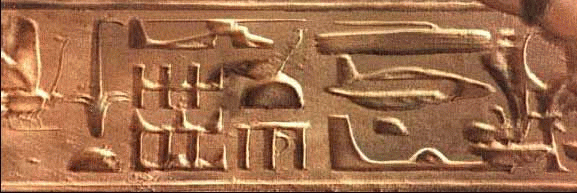
But the carvings were quite amazing. There they were—a few of them adjacent to each other, each apparently depicting something we’d recognize as a modern (or future) means of air travel. (I have my own photos, but it’s easier to link to photos online.)

Was this really evidence that the Egyptians knew how to fly—or at the least, had witnessed flying machines?

My immediate thought was an emphatic NO. Not simply because it sounds implausible, and not because I don’t believe in aliens. Even if it is possible, I had my own reasons: amongst other qualities, the Egyptians certainly had one—they were record-keepers. They kept extremely intricate records of everything they knew about—and repeated this knowledge everywhere they could: every temple, every column, every tomb.

Is it really possible that they witnessed something so—forgive my pun—out of this world, and only made ONE reference to it? One set of carvings, in one temple, located in a far corner, high above the ground, where it is easily missed? Now that is implausible.

Of course I looked online when I was back—and initially, this is the best explanation that I found. Apparently a set of carvings were recarved, i.e. more carvings were done on top of the original—each modification at different times, even—with the end result being what we see today. I did not like this explanation at all. The webpage has some detailed drawings, but—I didn’t like it. How many separate coincidences must there have been—over many centuries of recarvings, done intentionally by different sets of people—that such an intriguing piece would result? Again, implausible.

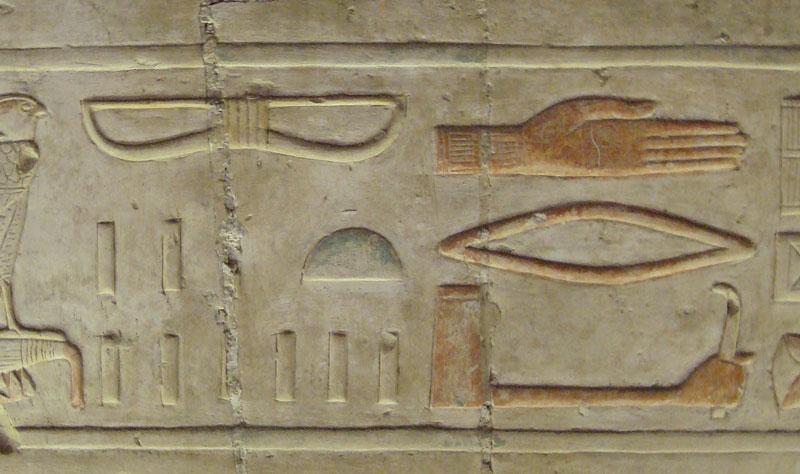
Now I’ve found a better explanation. And this involves more chance and less human intervention. Apparently there are other carvings found at the same temple, which have nothing at all to do with avionics, that can explain our mystery. It can be something as simple as an incomplete carving, coupled with damage over the millennia!

Seen side by side, this image and this one seem to indicate quite convincingly that our mystery panel was meant to be similar to the other, more conventional, carving.

Granted, it’s still quite a coincidence—alien theorists, you need not retire yet on this one—but it still seems an acceptable coincidence!

Are you convinced, or are you looking up at the sky, trying to look past those cloaking devices?

P.S.: It’s so easy to find anything alien related on the internet! The cloaking device thing was intended as a joke, stemming in large part from my teenage—and, ahem, later—Animorphs days. I did a Google search looking for interesting links, and voila!