➶ How the smallest programming bugs can be catastrophic

From way back in 1996:

It took the European Space Agency 10 years and $7 billion to produce Ariane 5, a giant rocket capable of hurling a pair of three-ton satellites into orbit with each launch and intended to give Europe overwhelming supremacy in the commercial space business.

All it took to explode that rocket less than a minute into its maiden voyage last June, scattering fiery rubble across the mangrove swamps of French Guiana, was a small computer program trying to stuff a 64-bit number into a 16-bit space.

One bug, one crash. Of all the careless lines of code recorded in the annals of computer science, this one may stand as the most devastatingly efficient.

More links here, and the report of the inquiry into the incident is archived here.

A fascinating, and from a programmer’s perspective chilling, read. This is the stuff of nightmares — an apparently innocuous line of code causing an exception that leads to disaster!

∞

Adios Cassini

A couple of months ago, 15 September to be precise, marked the end of an era in the human exploration of our solar system. The Cassini spacecraft was programmed to crash into Saturn’s upper atmosphere and burn up, thus ending an almost two-decade journey and exploration of Saturn and its moons. I was in middle school when this mission launched in 1997, and at that point, even reaching Saturn in 2004 seemed eons away. Twenty years later, perhaps it’s time to look back at some of the amazing insights we’ve gained.

Cassini is actually a shortened name for the Cassini-Huygens mission, and comprises the main spacecraft — Cassini — designed to travel as a satellite in the Saturn planetary system, and a small lander — Huygens — designed to actually land on Titan, Saturn’s largest moon.

Giovanni Cassini was an Italian mathematician and astronomer, and discovered four of Saturn’s moons — Iapetus, Rhea, Tethys and Dione. The Cassini spacecraft was the first to observe all four of these moons. Christiaan Huygens was, of course, a famous Dutch astronomer and scientist, and discovered — but of course — Titan, then the first known moon of Saturn. (He also invented the pendulum clock, was mentor to Gottfried Leibniz, studied optics and the wave nature of light, and derived the modern formula for centripetal force.)

Saturn by Cassini

Saturn by Cassini (via Wikipedia).

Of the many discoveries made by Cassini, I’ll focus on just two stories: those of Saturn’s largest moon Titan, and Saturn’s hexagon. Both of these fascinate me to no end, and I think reflect the best of Cassini’s contributions.

Saturn's Polar Hexagon

Jupiter is famous for its Great Red Spot; Saturn has its own atmospheric phenomenon that’s equally fascinating. Saturn’s Hexagon was first discovered by the Voyager missions, but now Cassini has had the chance to see it from up close.

Technically, the Hexagon is a persisting cloud pattern formed by jet streams around Saturn’s north pole, but its sheer size and perfect symmetry make it unique. Each side of the hexagon is about 13800km long (to compare, Earth’s diameter is about 12700km), and its winds travel at around 300km/h. It’s been there since the Voyager missions in the 1980s, so we know its long-lived.

Saturn - North polar hexagon and vortex as well as rings (April 2, 2014)

Saturn - North polar hexagon and vortex as well as rings (April 2, 2014) (via Wikipedia).

On Earth, our jet streams are forced to bend and move in response to Earth’s surface features such as mountains. Saturn is much larger than Earth (Saturn diameter is about 116000km) but has a rocky core that’s similar in size to Earth, and so its jet streams have no such problems, and can keep flowing in their own orderly and symmetrical fashion.

The hexagon is essentially a quirk of fluid mechanics. Here on Earth, scientists have been able to create (here, and here) such regular shapes by rotating a circular tank of liquid at different speeds at its center and outer edge. Due to the difference in speeds, a turbulent region is created where such regular shapes can be observed. The regular shape is not always a hexagon (shapes with three to eight sides, i.e. from a triangle to an octagon, are produced) but a hexagon is the most commonly occurring. However, the phenomenon only occurs when the speed differential and fluid properties fall under certain small margins, and therefore the hexagon phenomenon is not observed everywhere where its possible (such as Jupiter, or even the south pole of Saturn).

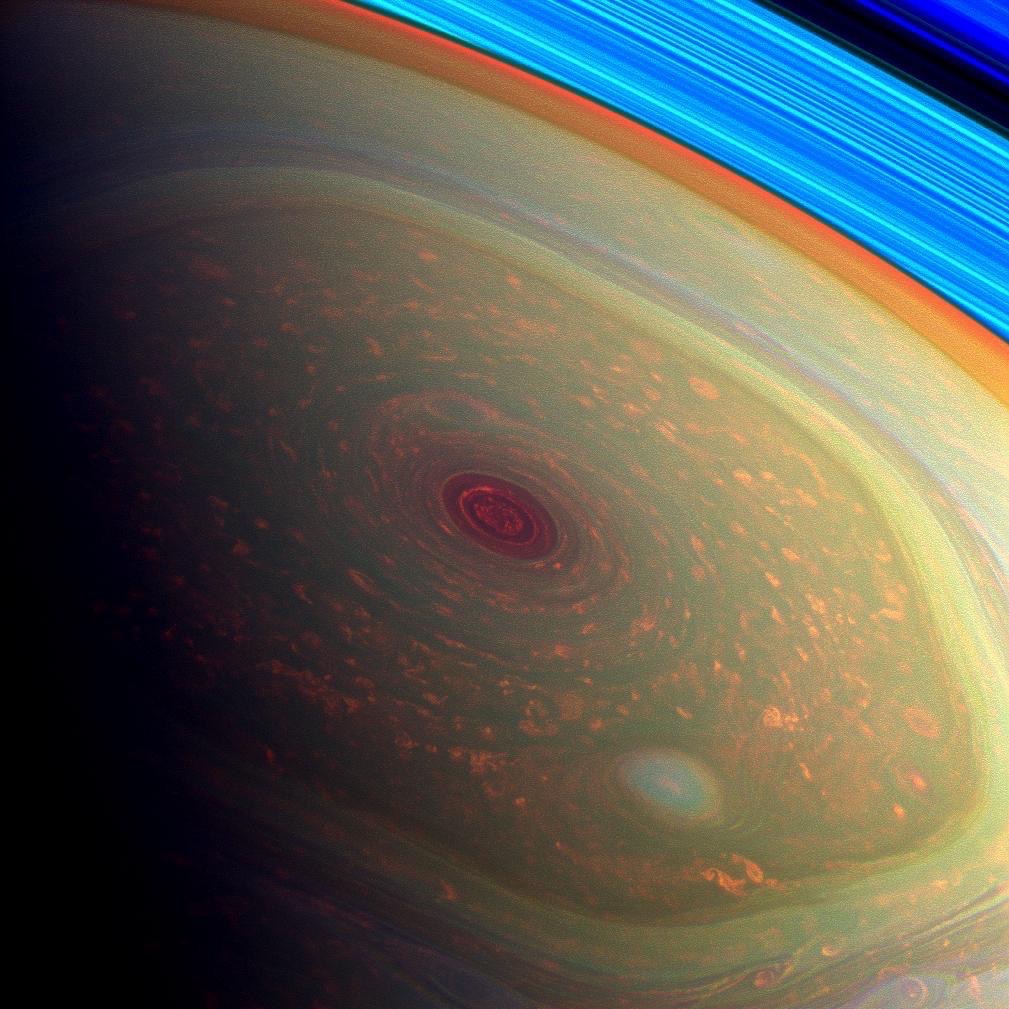
At the center of the Hexagon, right at the north pole, is a humongous storm, with a definite and easily observed eye wall. The south pole has such a storm as well, although it doesn’t display a Hexagon. In each case, the eye of the storm is about 50 times wider than a hurricane would be on Earth.

As much as the Hexagon is an atmospheric and scientific phenomenon, explained and replicated under lab conditions, it’s one of our solar system’s most beautiful sights, and something I’ll keep looking for in photos of Saturn, now that I know it’s there.

False color image of storms at Saturn's north pole

False color image of storms at Saturn’s north pole (via JPL/NASA).

Titan

Titan is Saturn’s largest moon, and of special interest to us: Titan is the only known moon with an atmosphere, and the only one other than Earth whose atmosphere is majority nitrogen. Moreover, its atmosphere is denser and more massive than ours, and is opaque at many wavelengths of light. This means that, like Venus, we had no idea of what the surface of Titan looks like until we had a probe that could land on the surface of Titan. Thanks to Cassini and Huygens, we know a lot more today about Titan than we did in 2004.

Titan, we know now, has an active weather system, including wind and liquid rain, just like on Earth. Of course, the liquid that rains is different from Earth: it rains liquid methane on Titan. Nevertheless, its nitrogen atmosphere and presence of liquids means that Titan’s methane cycle is analogous to Earth’s water cycle. Titan’s upper atmosphere is also affected by ultraviolet light from the Sun, whereby atmospheric methane is broken down and reconstituted into a diverse mix of complex hydrocarbons.

We’re not done yet with the comparisons with Earth! Titan has lakes and oceans, comprised of methane, ethane, and dissolved nitrogen; this makes Titan only the second object in the Solar System (after Earth) to have stable liquids present at ambient temperatures. It most likely also has volcanoes, and is affected by tidal effects from Saturn’s massive gravity. Titan’s surface, specifically where Huygens landed, looks uncannily like Earth, with ‘globules’ about 10-15cm in size, made probably of water ice.

Huygens' view of Titan's surface

Huygens’ view of Titan’s surface (via Wikipedia).

It’s almost as if Titan is an analogue of Earth— only much colder. In fact, in very specific ways it’s not even colder by much thanks to Titan’s greenhouse effect and tidal heating from Saturn. Cassini has performed numerous gravity measurements of Titan, which reveal that there is a hidden, internal, ocean of liquid water and ammonia beneath Titan’s surface.

So, to summarize, Titan has: an active weather system, large quantities of complex hydrocarbons (Titan is much, much richer in hydrocarbons than Earth), tidal effects from Saturn, and interaction of its atmospheric methane with ultraviolet radiation from the Sun, and even and underground ocean of liquid water and ammonia. A question is begging to be asked at this point: what are the chances of life (past, present or future) on Titan?

Scientists think Titan definitely has the potential to contain habitable environments. Similar to Earth in its infancy, Titan today has the pieces needed for new life to possibly form. Whether it already has, or the extent of future possibility, can only be understood with even better exploration. Indeed, quite a few ideas for future missions dedicated to Titan have been proposed, but none have really gotten off the ground (pun intended) yet.

The most promising of them all is a design to send a submarine to Titan that can explore the seas of Titan, but even this idea is in relatively early stages.

So Much More...

I’ve really just scratched the surface here of how much the Cassini mission gleaned from the Saturn system. There’s so much more: Saturn’s rings and their composition; the moon Enceladus and its jets of icy particles and subsurface ocean of salty water; the moon Iapetus and its equatorial ridge; the moon Mimas and its crater that gives it the Death Star look… trust me, if you don’t take an interest yet, you will once you start reading.

The Cassini-Huygens mission really gave us glimpses into a planetary system that provides great opportunities for scientific discovery, amazing new and diverse worlds, and even — dare we dream? — possibilities of places that can harbor life.

It’s time to say adios to Cassini, but of course, we humans have a long way to go before we can say we know our own solar system.

Saturn's moon Mimas, with the crater Herschel visible prominently

Saturn’s moon Mimas, with the crater Herschel visible prominently (via Wikipedia).

(This piece first appeared in the 2017 edition of Sharod Sombhar, an annual magazine from the Bengali Students’ Association at Virginia Tech.)


➶ Recent ISRO satellite launch carried special imaging constellation

From the website of the company ‘Planet’, published the same day the ISRO satellites were launched:

Today Planet successfully launched 88 Dove satellites to orbit — the largest satellite constellation ever to reach orbit. This is not just a launch (or a world record, for that matter!); for our team this is a major milestone. With these satellites in orbit, Planet will reach its Mission 1: the ability to image all of Earth’s landmass every day.

This constellation therefore formed the majority (88 of 104 satellites launched) of the payload carried by the last ISRO launch. As of this launch, Planet is operating 149 satellites in Earth orbit — this is no mean feat.

Also, an interesting side note: ISRO’s previous largest payload that I referred to in my last post — 20 satellites launched in June 2016 — also seems to be for this same company:

This is our 15th launch of Dove satellites and second aboard India’s PSLV. The launch of Flock 3p comes off the successful launch of Flock 2p on the PSLV in June 2016

∞

➶ Indian Space Research Organization launches satellites, breaks record

Indian Space Research Organisation (ISRO) scripted history today by successfully launching a record 104 satellites, including India’s earth [sic] observation satellite, on a single rocket from the spaceport in Sriharikota. This is the highest number of satellites ever launched in a single mission.

The previous record was held by Russia, with 37 satellites launched at one go. The 104 satellites include 3 of India’s own and 101 of ISRO’s international customers, including 96 from USA. (The article states ISRO’s previous record as 23 satellites launched together in June 2015, but I can’t find a record for that. The closest I could find was this: 20 satellites launched in June 2016.)

As much as this is making news, and as much as ISRO should be proud, this should come as no surprise for space enthusiasts— ISRO has been quite a force in space technology, especially using its PSLV launch system, for quite some time now.

The four stage Polar Satellite Launch Vehicle (PSLV), used for this launch, was developed by ISRO in the 1990s to launch satellites into Sun-synchronous orbits for its own remote sensing satellites. (Other than ISRO, only Russia commercially launches satellites into Sun-synchronous orbits.) PSLV was also used by ISRO for Chandrayaan 1, its lunar probe, and Mangalyaan, its Mars orbiter, becoming only the fourth space agency to reach Mars orbit.

As an aside, the Sun-synchronous orbit is a very interesting concept: it is an orbit where the satellite passes over any given point on Earth’s surface at the same local solar time. This allows the satellite to be in constant sunlight as it passes over particular regions— which is great for imaging, remote sensing, spying and weather applications. The technicalities of such an orbit are very involved and very interesting: look up the Wikipedia page I’ve linked to above.

Fun fact: due to the mechanics of the orbit, a sun-synchronous orbit is stable without external thrust only on oblate spheroid planets. This means that such orbits work on Earth and will work on Mars, but on almost spherical planets such as Venus, it will require external thrust to maintain its orbit.

∞

Of Space Worms

Found this article recently, where they wanted to check how microscopic worms would do in space. Turns out, they do fine—in fact, they actually live longer in space! Additionally:

“We identified seven genes, which were down-regulated in space and whose inactivation extended lifespan under laboratory conditions,” Szewczyk said in a press release. This basically means that seven C. elegans genes usually associated with muscle aging were suppressed when the worms were exposed to a microgravity environment. Also, it appears spaceflight suppresses the accumulation of toxic proteins that normally gets stored inside aging muscle.

They’re not sure what the biological mechanisms might be behind this phenomenon.

I wonder, though—how much of it can be simple chemistry and fluid dynamics? We know that at small enough length scales (such as those of microscopic organisms) viscosity is a much stronger agent than inertia (governed by mass, and to an extent, gravity). Often, gravitational effects are ignored when doing small scale analyses. How do things change in the actual biology when gravity is really zero, not just as an approximation?

Also from the article:

“Most of us know that muscle tends to shrink in space. These latest results suggest that this is almost certainly an adaptive response rather than a pathological one. Counter-intuitively, muscle in space may age better than on Earth. It may also be that spaceflight slows the process of aging.”

I’m not sure why this seems novel. My thought has always been that muscle atrophy in space is due to lack of use, i.e. adaptation. This is why astronauts take special care to exercise their leg muscles while at the International Space Station. The legs no longer need to support the considerable weight of the human body, and the body efficiently starts optimizing its resources!

But perhaps (and most likely) my lack of knowledge allows me to simplify a phenomenon that a physiologist would find many angles to! I’d love to know those angles though—anyone reading this who can help?