Of India’s high-speed rail ambitions, and lazy Indian journalism

India’s plans about building a high speed rail route connecting Mumbai and Ahmedabad have been in the news lately. The project is funded by a low-interest loan from Japan (covering 80% of the cost of the project), and will make use of Japanese high-speed rail technology used for the Shinkansen.

Of course, along with the project being in the news, it is also subject to critique in news articles, as any expensive government venture is bound to (and should!) be. In many of the articles, though, I found one common piece of information mentioned over and over:

According to a study conducted by IIM Ahmedabad, Ahmedabad-Mumbai bullet train will need to make 100 trips daily and carry 88,000-118,000 passengers per day to be financially viable. This figure could well be way above the total number of passengers travelling between the two cities on any given day.

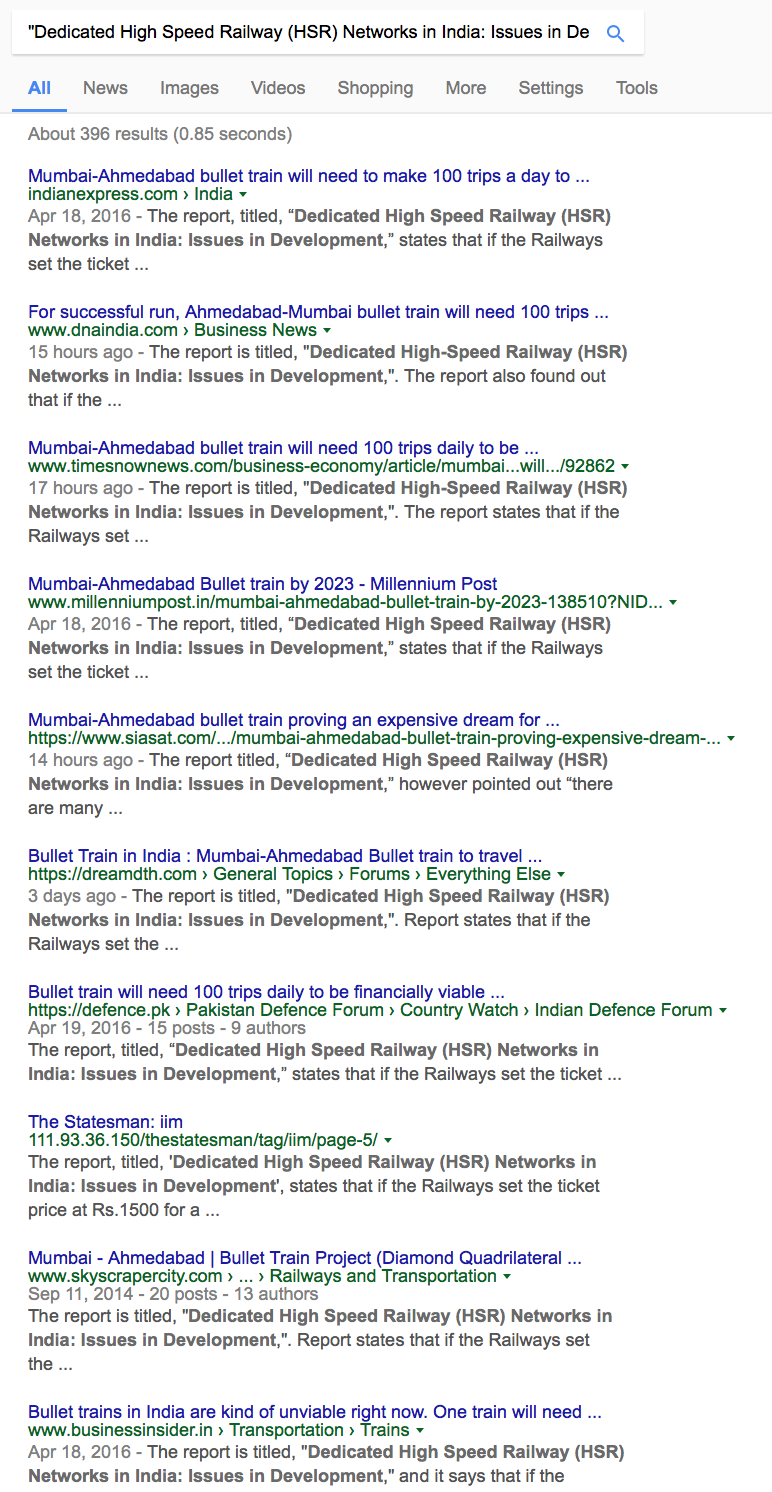
In fact, searching the internet with the name of the article in question (Dedicated High Speed Railway (HSR) Networks in India: Issues in Development) provides a result that looks like this:

Google Search Result

Google Search Result. (Source)

They all mention the same report, and all mention the exact same language about “requiring 100 trips a day”. None, however, actually provide links for the curious reader, nor provide any context or analysis. Well, I was curious, so I tried to find and read the actual report.

This is the the report I found online. It’s co-authored by Prof. G. Raghuram as mentioned in all the newspaper reports, and calls itself “an abridged version of an IIMA working paper with the same title.” Unfortunately, the IIMA working paper link is broken, and the Wayback Machine doesn’t have it archived either. (P.S.: Between the time that I found and read the report, and I finished writing this piece, the webpage hosting the report seems to have gone dead. No matter, the Wayback Machine has it cached. Go read!)

Anyhow, the report is a great read. After reading it, though, I was reminded of how poor India’s average journalism has come to be. What every news article printed is actually in the report being cited, and yet — and yet! — what they printed is a complete misrepresentation of the entire point and view of the report.

Let’s start with the conclusions of the report. The following are direct quotes from the Conclusions section:

  • Given that India is a developing country, the primary concern is whether the funds for such a project could be better utilised in other domains, including in upgrading conventional rail. However, the Japanese funding to the tune of 80% of the project cost may not be available for other uses.
  • there are many positive benefits and externalities of the HSR which would be useful in India’s overall aspirational development. These externalities include technology percolation into other domains, economic development, game-changing sense of connectivity, and national pride due to cutting-edge infrastructure. In such a context, it is a good idea to begin and learn.
  • The Mumbai-Ahmedabad route is a good choice for the first route, since it connects India’s first and seventh most populous cities, with significant economic development in the 500 km corridor between them.
  • The low cost Japanese financing has been a great catalyst. Though it is a tied funding with significant mandatory procurement from Japan, it cannot do much harm since Japan is at the cutting edge of HSR technology with over 50 years of experience.

Evidently, the overarching view of the article is not that “100 trips will be needed per day…”. Let’s talk about that part next, then. Here’s the crucial paragraph from the article:

Assuming that 20% (apart from the 80% Japanese funding at concessional rates) of the total cost of the Mumbai-Ahmedabad route would be funded by the Government of India (GoI) with an expected 8% annual return during the operational phase, the estimated daily financing costs for the route would be INR 106 million from when the repayment of the loan kicks in. We take this to be the 16th year (till when the Japanese loan has a moratorium), by when the ramp-up of traffic should have occurred. The project cost includes the ‘interest during construction’ for seven years. Over the remaining eight ramp-up years, we assume that there would be enough operating surplus to cover the interest payments. Subsequent to this, the GoI portion is treated as an equity with only interest due, but no principal repayment. Taking an average fare of INR 5.00 per km for the route with intermediate stops and for a scenario of 0.4 operating ratio, we arrive at a daily required ridership of 118,000 passengers (which translates to 43 million passengers annually). At an average of 1000 passengers per train, over 100 services per day (50 per direction) would be required.

What this means is that if the financing for the rail route is to be paid from the revenue from the rail route only, then about 118000 passengers, at an average of 1000 per train, over 100 services daily, would need to travel on the route. The newspaper articles only mention the raw number, with a vague notion that this is impractical or impossible to achieve. Two points should be considered, though. First, perhaps it isn’t necessary that revenue from the rail route matches the required financing. Perhaps the government can pay for the financing in the short term, and accrue revenue from the rail route to replenish its coffers in the longer term. Second, what is the context for the “1000 per train, 100 services daily” figure? How does it compare to other high speed rail systems in other countries?

Considering the second point first, here is literally the very next paragraph in the report:

The feasibility report estimates for 2033 with a train configuration of 10/16 cars (750/1200 seats) require 52 trains per day per direction. As of 2016, some of the high-traffic HSR routes like Paris-Lyon (409 km), Shanghai-Nanjing (311 km) and Tokyo-Shin Osaka (552 km), though being parts of bigger networks themselves, have more than 85, 300 and 330 trains respectively running every day.

Well, then! In context, the “100 trains per day” number doesn’t look so bad, does it? Considering this information, perhaps the first point above regarding financing isn’t that big a concern, either? It would seem so from the report, since it makes no further comment regarding this matter, including in its conclusions.

There are other points that the news articles mention, such as the 500km distance of the route, as being detrimental to the success of the project (“Flights only take one hour!”). Even those points are considered and answered in the report. The report really is worth the read.

The pros and cons of a large, time-consuming, and expensive government project should be debated — ernestly. However, the debate is derailed (forgive the pun) right at the beginning if the information being circulated is incomplete, or worse, plain wrong. Please, by all means, have the debate. Would everyone at least read the report that everyone is attempting to cite?

P.S.: Between the time that I found and read the report, and I finished writing this piece, the webpage hosting the report seems to have gone dead. No matter, the Wayback Machine has it cached. Go read!


☛ Radiolab Podcast: Using flickering lights to treat Alzheimer’s Disease

Today, a startling new discovery: prodding the brain with light, a group of scientists got an unexpected surprise – they were able to turn back on a part of the brain that had been shut down by Alzheimer’s disease. This new science is not a cure, and is far from a treatment, but it’s a finding so … simple, you won’t be able to shake it. Come join us for a lab visit, where we’ll meet some mice, stare at some light, and come face-to-face with the mystery of memory. We can promise you: by the end, you’ll never think the same way about Christmas lights again.

I’ve been meaning to post about this particular episode ever since I listened to it. This is the Nature paper about this study. They found that simply flashing light of a certain frequency at a certain interval helps with some of the brain waves that are diminished in mice with Alzheimer’s. It’s absolutely fascinating.

(I’m not going into too much technical jargon here; go listen to the episode!)

If you don’t listen to Radiolab in general, you definitely should; it’s one of the best podcasts there are.


UK Election: Interesting logistics of the Queen’s speech

In light of the recent election in the UK, the Queen, of course, is supposed to make a speech regarding forming the government by the party that has won majority. Now, however, after the interesting results of the election, the Queen’s speech is delayed, and the reason for it is very interesting.

The Telegraph UK reports:

The Queen’s Speech is going to be delayed because it has to be written on goatskin paper and the ink takes days to dry.

Apparently, the British monarchy are more concerned than others would be about the archival qualities of the paper that they use.

[…] goatskin paper is not actually made from goatskin.

The material is in fact high-quality archival paper which is guaranteed to last for at least 500 years.

Well, okay, but still, why the delay?

Well, ink on this special paper takes a few days to dry. And the monarchy had “ready to go” versions of the speech for (a) a Conservative party majority, and (b) a Labour party majority. But the results of the election, that resulted in a hung parliament, has put all pre-made plans into disarray. Since the political parties themselves don’t know yet how the government will be formed, the Queen’s speech isn’t finalized yet either.

Once the details are set in stone they can be committed to the goatskin paper and sent away for binding before being presented to the Queen.

I love how even the most apparently mundane things become fascinating just by being associated with the British monarchy.


☛ Everyday bat vocalizations are rich and complex

In this study, we continuously monitored Egyptian fruit bats for months, recording audio and video around-the-clock. We analyzed almost 15,000 vocalizations, which accompanied the everyday interactions of the bats, and were all directed toward specific individuals, rather than broadcast. We found that bat vocalizations carry ample information about the identity of the emitter, the context of the call, the behavioral response to the call, and even the call’s addressee. Our results underline the importance of studying the mundane, pairwise, directed, vocal interactions of animals.

This is brilliant. They were able to correlate their data analysis of the bats’ vocalizations with the behavior and responses that they observed… so now we know more about how bats communicate! Simply by listening to the vocalization, the context, addressee, and even “the outcome of the interaction can be predicted above chance level”. Fascinating.

From the discussion:

It is important to note that we used one set of acoustic features for classification. However, many other multi-dimensional spectro-temporal representations can be tested. The bat’s brain could thus be using some other representation that encapsulates much more information regarding different social aspects. The bat may be able to classify the context of an interaction with higher confidence, based on some acoustic feature which it evolved to use and is yet to be determined. Our analysis is thus probably only a lower bound on what a bat is capable of extracting from aggressive social vocalizations. For example, we did not include any temporal information in our analysis.

In any acoustic signal, and especially where communication is involved, the time parameter is usually crucial and will add rich layers of information. For example, just imagine taking a piece of human speech, and (a) only looking at the overal speech parameters, versus (b) observing how the speech parameters change during the speech. Case (b) will provide far more information than case (a). I think we will discover over time that bats have a pretty well-evolved communication scheme.

This is fascinating stuff.


☛ How Bayesian inference works

Bayesian inference is a way to get sharper predictions from your data. It’s particularly useful when you don’t have as much data as you would like and want to juice every last bit of predictive strength from it.

Although it is sometimes described with reverence, Bayesian inference isn’t magic or mystical. And even though the math under the hood can get dense, the concepts behind it are completely accessible. In brief, Bayesian inference lets you draw stronger conclusions from your data by folding in what you already know about the answer.

An excellent, simple introduction to Bayesian inference. This uses practical examples and an abundance of visual guides: especially useful if you don’t have an extensive math background.